Last updated on
Best LLM for code generation in 2026
“Best LLM for code generation” has a different answer depending on whether you mean writing a function, refactoring across a repo, or handing an agent a whole task. There’s no single winner. But there is a clear shortlist, and a sensible default for most people.
Here’s how we rank them, and which to actually use.
The short ranking
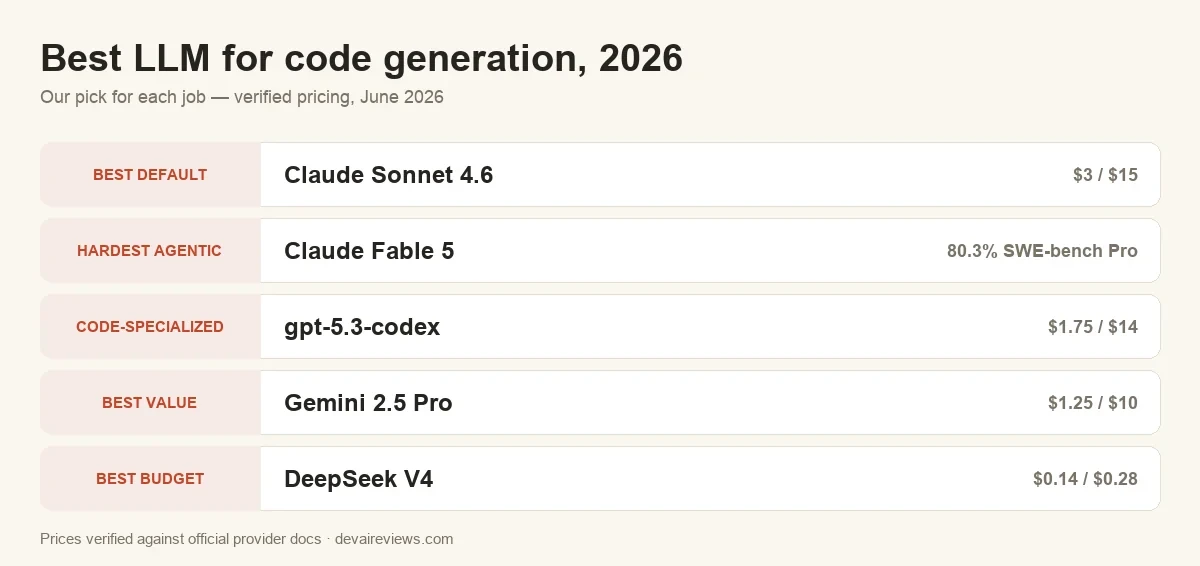
- Claude (Sonnet 5, Opus 5, Fable 5) — the strongest on agentic coding, where the model reads a repo and ships a working fix. Best default for most developers, and the top of the field for hard work.
- OpenAI GPT-5, with
gpt-5.3-codex— a code-specialized model at a lower price, plus a capable flagship. The value pick if you want a model purpose-built for code. - Google Gemini (3.1 Pro, 2.5 Pro) — frontier-class coding at the best price-to-capability ratio, with large context windows.
- DeepSeek V4 — the budget champion. Good enough for most well-scoped code at a fraction of the cost.
The rest of this is what earns each spot.
How we judge code generation
A model that writes plausible-looking code isn’t the same as one that writes working code. The things that actually matter for code generation:
- Correctness on real tasks. The benchmark worth caring about is SWE-bench Pro — real GitHub issues where the model has to read the repo, find the problem, and produce a fix that passes. It’s much closer to real engineering than “complete this snippet.”
- Agentic ability. Can the model run a loop — write, test, read the failure, fix — without losing the thread? This is where most of the practical value of code generation lives in 2026.
- Cost. Code generation is output-heavy, so the output price drives the bill. A model that’s 5% better but 5× the price rarely wins.
- Context window. Generating code that fits an existing codebase means feeding that codebase in. Bigger context helps.
1. Claude — the agentic-coding leader
Claude’s lineup leads where it counts most for code: agentic work. Claude Fable 5 scores 80.3% on SWE-bench Pro, the highest of any current model on that benchmark, and it’s built for long autonomous runs on hard problems. Opus 4.8 sits at 69.2% on the same test (its successor Claude Opus 5 launched July 24, 2026 at the same $5/$25 price), and Sonnet 5 — Anthropic’s June 30 update, replacing Sonnet 4.6 — closes most of that gap at 63.2%, a substantial jump from Sonnet 4.6’s 58.1%.
For most developers, the right Claude model isn’t the flagship — it’s Sonnet 5 at $3/$15 per million tokens ($2/$10 introductory pricing through August 31, 2026). It’s fast enough for interactive coding, capable enough for real tasks, and cheap enough to leave running all day. Step up to Opus 5 ($5/$25, the current Opus tier) when quality is the constraint, and to Fable 5 ($10/$50) only for the hardest, longest agentic jobs — it’s slow and expensive by design, built for async work rather than chat.
Anthropic doesn’t ship a separate code-only model. The bet is that a strong general model with a coding-first default beats a narrow one, and on agentic benchmarks that bet is paying off.
2. OpenAI GPT-5 — the code-specialized option
OpenAI’s distinctive move for code generation is gpt-5.3-codex ($1.75/$14), a model tuned specifically for writing and editing code rather than general reasoning. It sits below the flagships on price. That makes it a strong value for developers whose workload is mostly code.
Above it, gpt-5.5 ($5/$30) is the flagship for mixed coding-and-reasoning work, and gpt-5.4 ($2.50/$15) is a strong daily driver. If your team already works in ChatGPT or Codex, a GPT-5 model is the lowest-friction choice, and the codex variant gives you a purpose-built coding model that Claude’s lineup doesn’t directly match on price.
3. Google Gemini — the value pick
Gemini gives you frontier-class code generation without the flagship price. Gemini 2.5 Pro at $1.25/$10 is the best straight value in the field for coding, and Gemini 3.1 Pro ($2/$12 up to 200K tokens) is Google’s top coding-and-reasoning model, still in preview. Between them sits the generally available 3.x Flash line — 3.6 Flash at $1.50/$7.50 and 3.5 Flash-Lite at $0.30/$2.50. If your work is output-heavy, which code generation usually is, 3.6 Flash undercuts 2.5 Pro by $2.50 per million output tokens; check your own ratio against the price list. The large context windows help when you’re generating code against a big existing codebase.
If budget matters but you don’t want to drop to a discount provider, Gemini is the model we’d point most teams toward first.
4. DeepSeek V4 — the budget champion
DeepSeek is the cheapest usable tier, and it’s not close. deepseek-v4-pro runs $0.435/$0.87 per million tokens and deepseek-v4-flash $0.14/$0.28.
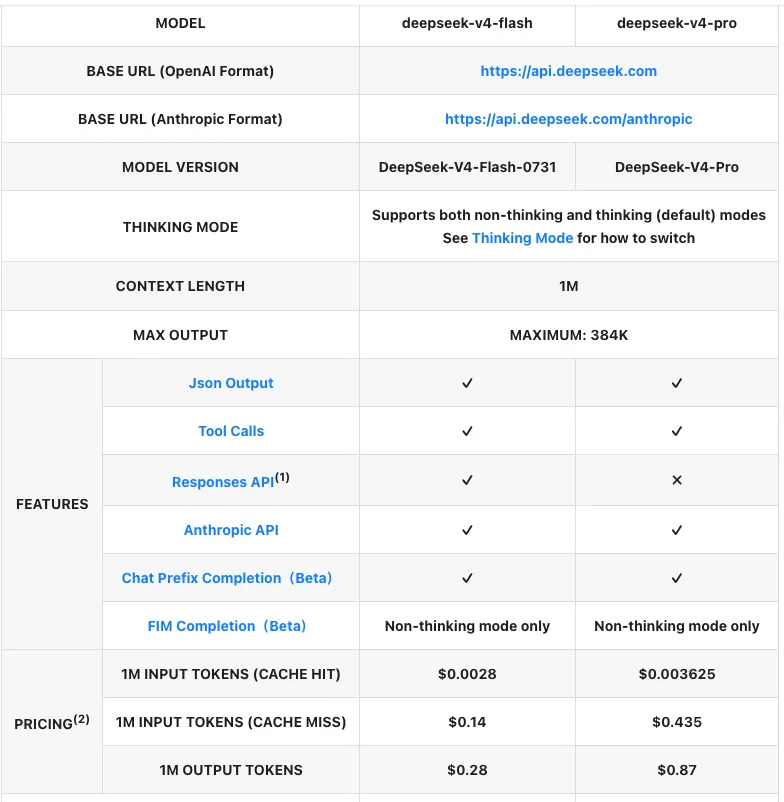
Those are DeepSeek’s own published rates, and the cache-hit row is the one worth noticing: repeated input drops to $0.0028 per million tokens on Flash. That’s where the cost of an agent re-reading the same files stops mattering. At those prices, high-volume code generation — running an agent across thousands of tasks, generating code for every file in a large repo — becomes economically routine.
The trade-off is that DeepSeek sits behind the frontier models on the hardest reasoning and agentic tasks. For well-scoped, high-volume code generation, that trade is often worth it.
What we saw running the same task on all three
To sanity-check the ranking, we handed the same non-trivial task to Claude Sonnet 4.6, gpt-5.3-codex, and Gemini 2.5 Pro and watched how each one did — first-pass correctness, how many rounds to shippable code, and how the result read. The task wasn’t toy boilerplate: a full CRUD API for “nesting jobs” in a real stone-cutting project, wired into an existing guillotine-packing engine, plus a 10-plus-test suite covering the awkward cases (pieces that don’t fit, rotation on and off, multi-slab jobs, kerf and margin validation). Stack: Python 3.12, FastAPI, Pydantic v2, SQLAlchemy 2.0, tested with pytest and httpx. That mix — routine CRUD on one side, domain-specific integration on the other — is where models tend to separate.
A note on timing: this run predates Sonnet 5, which replaced Sonnet 4.6 on June 30, 2026 and posted a real jump on agentic-coding benchmarks (58.1% → 63.2% on SWE-bench Pro). We haven’t re-run this specific task on Sonnet 5 yet — the results below reflect Sonnet 4.6 as tested. We’ll update this section once we do.
Claude Sonnet 4.6 was the most consistent. It usually got to clean, idiomatic code in one or two passes, with sensible error handling and tests that covered the obvious edge cases without being asked. When it did miss, it fixed its own mistakes coherently rather than thrashing. For everyday coding it’s close to overkill in a good way.
gpt-5.3-codex was the fastest to a complete, working scaffold — full structure, sensible defaults, and the strongest test suites of the three, often right on the first try. It can be a touch verbose, but it’s the one we’d reach for when the goal is “get a working thing done quickly.” It shines in terminal and agentic setups.
Gemini 2.5 Pro was quick to generate and good for prototyping, but the most variable. It occasionally shipped thinner tests, missed an edge case, or introduced a small bug that took an extra round to clean up. Strong if you’re iterating fast or already in Google Cloud; it needed a little more polish before the code was production-ready.
The honest caveat: for plain CRUD the three are close enough that the difference barely shows. The gaps widen on harder work — multi-file changes, concurrency, legacy code. And a sharp prompt (framework, style, test coverage, error handling spelled out) narrows the gap for all three. Run your own task on your own stack before committing; it’s cheap and tells you more than any table.
The full comparison
| Model | Provider | Input / 1M | Output / 1M | Code niche |
|---|---|---|---|---|
| Claude Fable 5 | Anthropic | $10 | $50 | Hardest agentic coding (80.3% SWE-bench Pro) |
| GPT-5.5 | OpenAI | $5 | $30 | Top general + coding |
| Claude Opus 5 | Anthropic | $5 | $25 | Current Opus tier |
| Claude Sonnet 5 | Anthropic | $3 | $15 | Best default for daily coding |
| GPT-5.4 | OpenAI | $2.50 | $15 | Strong daily driver |
| gpt-5.3-codex | OpenAI | $1.75 | $14 | Code-specialized value |
| Gemini 3.1 Pro | $2 | $12 | Value frontier coding | |
| Gemini 2.5 Pro | $1.25 | $10 | Best straight value | |
| Gemini 3.6 Flash | $1.50 | $7.50 | Cheaper output than 2.5 Pro | |
| Claude Haiku 4.5 | Anthropic | $1 | $5 | High-volume, cheap |
| DeepSeek V4 Pro | DeepSeek | $0.435 | $0.87 | Capable on a budget |
| DeepSeek V4 Flash | DeepSeek | $0.14 | $0.28 | Cheapest usable tier |
A note on benchmarks: only the Claude SWE-bench Pro figures here are verified against the source. Scores floating around for the GPT-5, Gemini, and DeepSeek models come from a different benchmark variant (SWE-bench Verified) and from leaderboards we can’t stand behind, so we’ve left direct numeric comparisons out rather than mix non-comparable tests. Check each provider’s official model card for its own results.
Best LLM for your situation
Best overall default: Claude Sonnet 5. Fast, strong on real coding, and priced to leave on all day.
Best for the hardest agentic work: Claude Fable 5. Top SWE-bench Pro score, built for long autonomous runs — used async, not in a chat loop.
Best code-specialized model: gpt-5.3-codex. Purpose-built for code at a mid-tier price.
Best value: Gemini 2.5 Pro. Frontier-class coding at $1.25/$10.
Best on a budget: DeepSeek V4. Capable code generation at well under a dollar per million output tokens.
The honest take
For most developers, this decision is smaller than it looks. Claude Sonnet 5 is the default that rarely disappoints, gpt-5.3-codex is the value option if you want a code-specialized model, and Gemini 2.5 Pro is the budget-conscious frontier pick. The way to choose between them isn’t a benchmark table — it’s running your actual task on two of them and seeing which writes code you’d actually ship.
See also: Best AI models for developers in 2026 · The complete guide to AI coding assistants · Cursor vs GitHub Copilot · All our model and tool comparisons
Frequently asked questions
What is the best LLM for code generation in 2026?
For most developers, Claude Sonnet 5 is the best default — fast, capable, and priced for everyday coding. For the hardest agentic work, Claude Fable 5 holds the top SWE-bench Pro score at 80.3%. For a coding-specialized model at a lower price, OpenAI gpt-5.3-codex is the strongest value.
Is there an LLM made specifically for code generation?
Yes. OpenAI gpt-5.3-codex is tuned specifically for code generation and editing, priced at $1.75 input and $14 output per million tokens — below the general flagships. Anthropic takes a different approach: a general lineup where Claude Sonnet 5 is the coding default rather than a separate code-only model.
What is the cheapest good LLM for generating code?
DeepSeek V4 Flash at $0.14 input and $0.28 output per million tokens is the cheapest on output, and code generation is output-heavy. Gemini 2.5 Flash-Lite is cheaper on input at $0.10 but charges $0.40 on output. Both handle routine and high-volume code generation well, though they trail the flagships on the hardest tasks.
Which LLM is best for agentic coding?
Claude leads on agentic coding benchmarks. Claude Fable 5 scores 80.3% on SWE-bench Pro, the highest of any current model, and is built for long autonomous runs. For interactive agentic work most developers use Claude Sonnet 5 or Opus 4.8.