
Last updated on
Claude models compared: Fable 5 vs Opus 4.8 vs Sonnet 5 vs Haiku 4.5
Anthropic ships four Claude models, and choosing between them comes down to one rule: use the cheapest tier that clears the task. Sonnet 5 is the everyday default, Haiku 4.5 covers high-volume work, Opus 4.8 steps up when quality is the constraint, and Fable 5 is reserved for the hardest async jobs. The rest of this comparison is the evidence behind that ordering: benchmarks, pricing, latency, context, and the API differences that actually bite.
Update (July 24, 2026): Anthropic has since released Claude Opus 5, now the current Opus-tier model — it supersedes Opus 4.8 at the same $5/$25 pricing. The lineup, benchmarks, and charts below were compiled before Opus 5 and still reference Opus 4.8; we’ll refresh them once independent Opus 5 numbers are in. For what changed, see our Claude Opus 5 explainer.
The current lineup
As of mid-2026, Anthropic’s lineup is four models:
- Claude Fable 5 (
claude-fable-5) — flagship, released June 9, 2026 - Claude Opus 4.8 (
claude-opus-4-8) — the high-end Opus tier, now succeeded by Claude Opus 5 (July 24, 2026) at the same price - Claude Sonnet 5 (
claude-sonnet-5) — speed and quality balanced; the default on Free and Pro, released June 30, 2026 (it supersedes Sonnet 4.6, now a legacy model) - Claude Haiku 4.5 (
claude-haiku-4-5) — fastest, lowest cost
There’s also Claude Mythos 5 (claude-mythos-5) — same specs and pricing as Fable 5, but invite-only through Project Glasswing. If you don’t have access, Fable 5 is the equivalent.
One caveat on availability before the numbers: Fable 5 had a nearly three-week outage this year. On June 12, 2026, Anthropic turned off both Fable 5 and Mythos 5 for every customer to comply with a US export-control directive tied to a jailbreak finding. Access came back on July 1, and through July 7 Fable 5 usage counts toward up to 50% of a plan’s weekly limit before switching to usage credits. Worth factoring in if you’re leaning on it for anything time-sensitive. See our Claude Fable 5 explainer for the full story.
Coding benchmarks
The most cited benchmark for agentic coding ability is SWE-bench Pro — a set of real GitHub issues where the model must read the repo, diagnose the bug or feature request, and produce a working fix. It’s close enough to real engineering work that the scores mean something.
Fable 5 leads the field on SWE-bench Pro — 11 points over Opus 4.8 and more than 20 over GPT-5.5 and Gemini 3.1 Pro — and the gap widens on harder, longer tasks. The clearest illustration is FrontierCode, Cognition’s evaluation scored on the hardest 50 of 150 coding tasks (the “Diamond” subset). At its highest effort setting, Anthropic reports Fable 5 at 29.3%, more than double Opus 4.8’s 13.4% and over five times GPT-5.5’s 5.7%.
Those are small absolute numbers — these problems are built to be brutal — but the relative gap is the point: on the work that breaks other models, Fable 5 pulls away.
What that means in practice: Fable 5 and Opus 4.8 produce similar quality on short to medium coding tasks. The gap opens when the task runs long — large migrations, multi-file refactors, sustained agentic loops where the model has to hold context across many steps without drifting. Anthropic’s headline example: a 50-million-line Ruby codebase migrated in a day, work it estimates would have taken a team more than two months by hand.
Sonnet 5 is stronger for everyday coding than a benchmark table suggests — it’s the right default for the interactive coding that makes up most of a developer’s day.
Pricing
Fable 5 costs 10× more per output token than Haiku 4.5 and 2× more than Opus 4.8. Most workloads are output-heavy, so the output price is what drives the bill (current rates are on Anthropic’s pricing page). Generating 100K output tokens on Fable 5 costs $5; the same volume on Haiku costs $0.50.
For a production pipeline running thousands of requests a day, that gap becomes the architecture conversation. Use the most powerful model the task requires — not the most powerful model available.
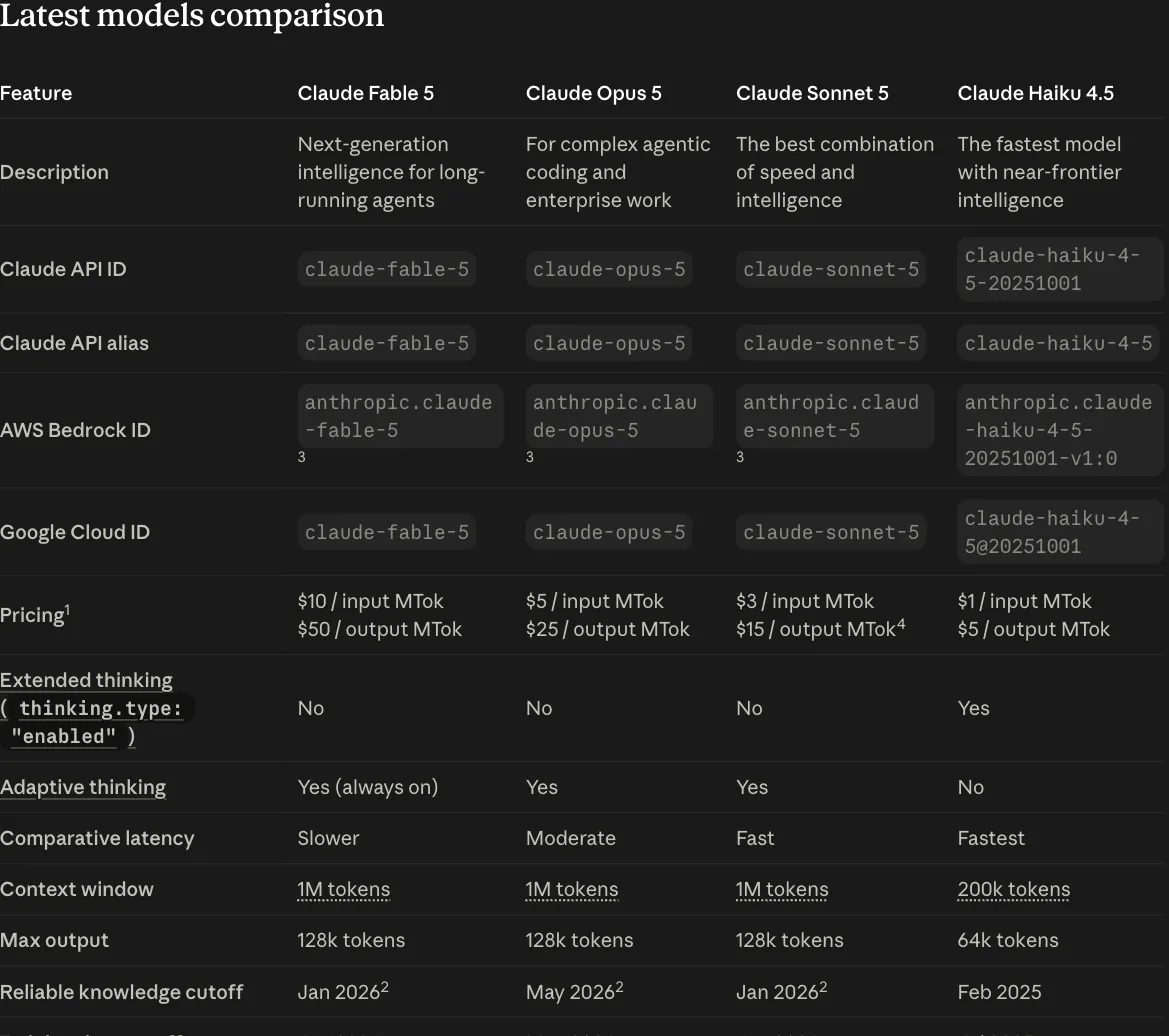
Anthropic publishes the same comparison in its own docs, which is the reference to check when these numbers move — note that the table now shows Opus 5 in the slot Opus 4.8 held, at the same $5/$25.
Context window and output capacity
Fable 5, Opus 4.8, and Sonnet 5 all return up to 128K tokens per response — double Haiku 4.5’s 64K ceiling. That matters for tasks that produce long uninterrupted output: generating large files, detailed technical reports, or extended agent turns without truncation.
Haiku 4.5 is the outlier on context: 200K tokens instead of 1M. That’s still large enough for most tasks, but it rules Haiku out for feeding entire large codebases in a single prompt.
Latency
| Model | Output throughput | Typical coding task | Sync use? |
|---|---|---|---|
| Haiku 4.5 | ~95 tok/s | Under 1s | Yes |
| Sonnet 5 | ~40–60 tok/s | 2–5s | Yes |
| Opus 4.8 | — | 3–15s | Yes, with patience |
| Fable 5 | — | 60s–several minutes | No |
Anthropic publishes only qualitative latency tiers (fast, fastest, and so on), so the throughput figures above are representative ballparks, not official numbers; the per-task ranges reflect typical interactive coding work. The pattern is what matters, and it’s stark at the bottom of the table. A coding task that Opus 4.8 finishes in 3–15 seconds can take Fable 5 a minute or more — and a multi-step run with tool use can take 30 minutes to several hours. That’s by design: Fable 5’s intended use pattern is “hand it a complete task and come back to a result,” not “ask it questions and wait for answers.”
Opus 4.8 also has a “fast mode” (a research preview on the Claude API) that runs the same model at up to 2.5× the output speed for premium pricing, which makes its 3–15s range feel much more practical for real workloads.
Rule of thumb: if a human would wait at a keyboard for the response, use Sonnet 5 or Haiku 4.5. If the model is running in the background as part of an automated pipeline, Opus 4.8 or Fable 5 are appropriate.
Thinking modes
| Model | Adaptive thinking | Extended thinking |
|---|---|---|
| Fable 5 | Always on — can’t disable | No |
| Opus 4.8 | Yes (configurable) | No |
| Sonnet 5 | Yes | No |
| Haiku 4.5 | No | Yes |
Adaptive thinking (thinking: {type: "adaptive"}) scales internal reasoning to the task. Fable 5 always runs it — you can’t turn it off. Extended thinking (thinking: {type: "enabled", budget_tokens: N}) is the explicit, budget-controlled version. Code using budget_tokens on Fable 5 or Opus 4.8 gets a 400 error — use {type: "adaptive"} or omit the parameter entirely. Sonnet 5 supports only adaptive thinking (there’s no extended-thinking mode), so write new code against {type: "adaptive"} there as well.
Refusals and fallback on Fable 5
Fable 5 carries one behavior the rest of the lineup doesn’t: safety classifiers that can decline a request outright. Opus 4.8, Sonnet 5, and Haiku 4.5 don’t run these classifiers, and neither does Mythos 5. When Fable 5 declines, the Messages API returns a normal HTTP 200 with stop_reason: "refusal" rather than an error, so code that reads the response content without checking stop_reason first will treat a refusal as an empty answer.
The practical risk is false positives. The classifiers sometimes fire on legitimate adjacent work — security tooling or life-sciences tasks, for instance — not just genuinely unsafe requests. A request refused before any output isn’t billed, but you still need a recovery path.
That path is fallback: re-serve the refused request on another model, usually Opus 4.8. Anthropic supports it server-side (a fallbacks parameter, in beta), through SDK middleware on the client, or hand-rolled. Wire it in from the start rather than meeting the behavior in production. See Anthropic’s refusals and fallback guide for the response shapes and handling.
Knowledge cutoffs
| Model | Reliable cutoff | Training cutoff |
|---|---|---|
| Opus 4.8 | Jan 2026 | Jan 2026 |
| Sonnet 5 | Jan 2026 | Jan 2026 |
| Haiku 4.5 | Feb 2025 | Jul 2025 |
Haiku 4.5’s reliable cutoff of February 2025 is the most limited. It matters if the task touches any tooling or APIs released since early 2025. These dates come from Anthropic’s model documentation.
Which model to use
Haiku 4.5 — the default for anything high-volume, latency-sensitive, or cost-constrained. Classification, summarization, short completions, quick Q&A. At $1/$5 per million tokens it covers the majority of real tasks.
Sonnet 5 — the daily-driver for most developers, and Anthropic’s default on Free and Pro. Fast enough for interactive use, capable enough for real coding tasks, and at $3/$15 per million tokens ($2/$10 introductory through Aug 31, 2026) it costs a fraction of Opus.
Opus 4.8 — when quality is the constraint, not cost. Complex multi-step reasoning, long agentic coding runs, tasks that need 128K output. The effort parameter defaults to high on Opus 4.8, applying more reasoning automatically.
Fable 5 — for the hardest problems: long migrations, deep debugging across large codebases, agentic runs that span many steps. 80.3% on SWE-bench Pro, the top of the field. Run it on async/batch workloads, not in a synchronous chat loop, and budget for the refusal fallbacks covered above.
All four models share the same API, tool use, and vision support, so moving between tiers is a one-line change to the model string. That’s the real point: you don’t commit to a model, you route to one. Let task complexity, request volume, and budget decide which. For how Claude stacks up against other vendors, see our other model comparisons.
See also: Best AI models for developers in 2026 · Best LLM for code generation · AI coding assistants guide
Frequently asked questions
Which Claude model is best for coding?
For raw agentic-coding ability, Claude Fable 5 leads on SWE-bench Pro (80.3%) — but it's slow and expensive, so it's for hard async work, not chat. For the interactive coding most developers do all day, Claude Sonnet 5 is the right default; Opus 4.8 covers the serious work that doesn't quite need the flagship.
How much do the Claude models cost?
Per million tokens (input/output): Claude Fable 5 is $10/$50, Opus 4.8 is $5/$25, Sonnet 5 is $3/$15 ($2/$10 introductory through Aug 31, 2026), and Haiku 4.5 is $1/$5. Output price drives most bills since real workloads generate more than they consume. Verified against Anthropic's API docs, July 2026.
What's the difference between Claude Fable 5 and Opus 4.8?
Fable 5 sits above Opus 4.8: double the price, the highest agentic-coding scores, but much slower (it always reasons, built for async background work). Opus 4.8 is faster — it has a fast mode — and cheaper. On short to medium tasks they're similar; the gap opens on long migrations and sustained agent runs where Fable 5 holds context without drifting.
Which Claude model should I use by default?
Start with Sonnet 5 — released June 30, 2026 and now the default on Free and Pro, it's fast enough for interactive use and capable enough for real coding, at a fraction of Opus's price. Drop to Haiku 4.5 for high-volume, latency-sensitive, or cost-constrained work; step up to Opus 4.8 when quality is the constraint; and reserve Fable 5 for the hardest async problems.