Last updated on
Claude vs Codex: which AI coding tool wins in 2026?
Search “Claude vs Codex” in 2026 and you’re really asking two questions at once. One is about the tools — Anthropic’s Claude Code against OpenAI’s Codex, the two agentic coding assistants most engineers actually reach for. The other is about the models underneath them. We’ll take the tools first, because that’s where the day-to-day difference lives, then look at the models and price.
Key takeaways
- Both are agents, not autocomplete. Claude Code and Codex each write code, run commands, read the output, and iterate on what breaks.
- The old split has blurred. Claude Code was the agent you sit with and Codex the one you delegate to; Claude Code now has its own async cloud agent too (Claude Code on the web, at
claude.ai/code), it’s just newer and still in research preview. - For hand-off work, Codex is the more mature option today. Its cloud agent has been generally available longer, and that’s the workflow with the track record behind it.
- Neither is billed per token. Claude Code comes bundled with a Claude Pro subscription; Codex is bundled into ChatGPT’s plans.
- The deciding question is steering versus delegating, not which tool is more capable. Most teams would be productive on either.
If you want to watch an agent work and steer it, both do that well from their CLIs. If you want to hand off a task and get a pull request back, both can now do that — Codex’s version is just the battle-tested one.
What each tool is
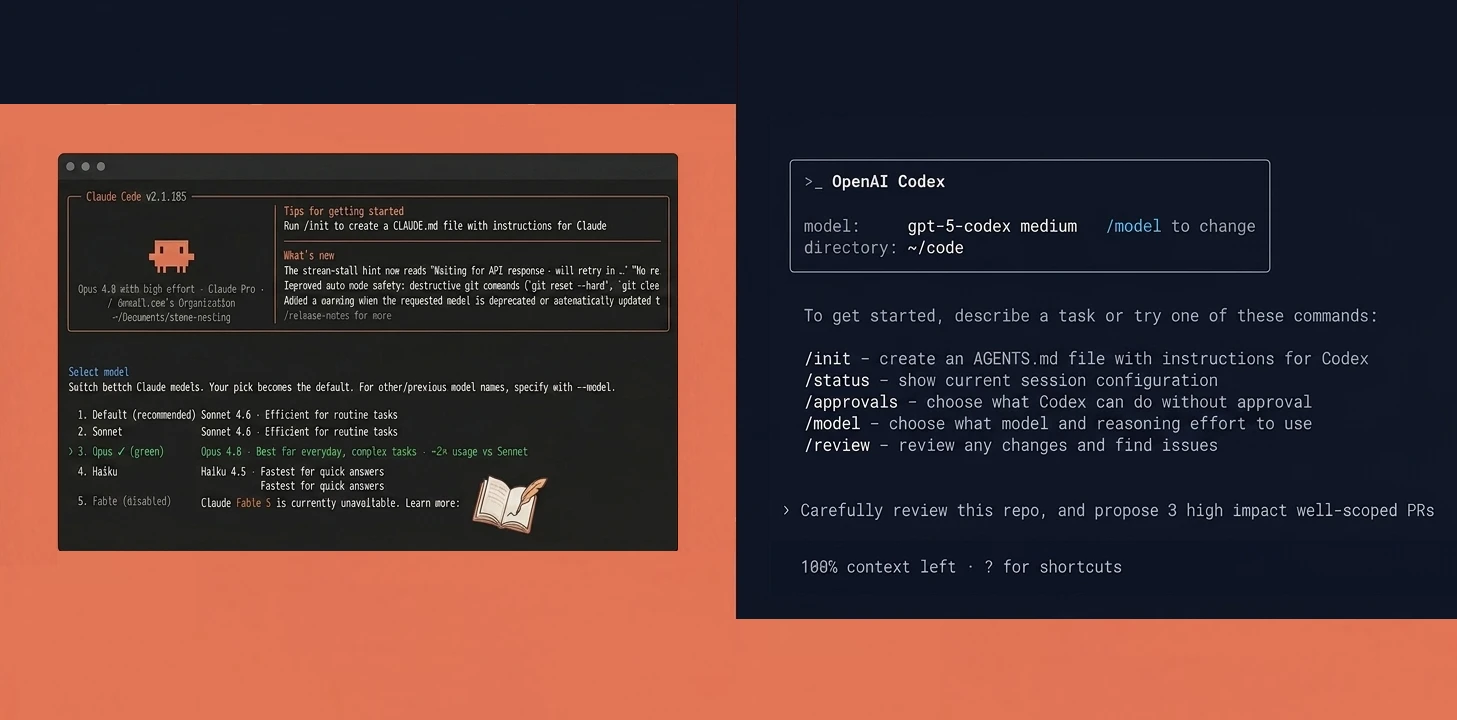
Claude Code is Anthropic’s agentic coding tool. It started as a command-line tool you run in any terminal against any codebase, and that’s still its center of gravity. It now also ships editor integrations — a VS Code and JetBrains side panel — plus Claude Code on the web at claude.ai/code: a research-preview cloud version that connects to GitHub, runs tasks on Anthropic-managed sandboxes, persists sessions even if you close the browser, and can be monitored from the Claude mobile app — including auto-fixing a PR if CI fails or a reviewer leaves comments. Whichever surface you pick, it talks to Claude models directly: Sonnet 5 for fast interactive work, Opus 4.8 for heavier jobs, and Claude Fable 5 — Anthropic’s top-scoring coding model, which had a brief export-control suspension in June (more on that below) but is available again — for the hardest long-horizon runs. It keeps project context in a CLAUDE.md file you commit to the repo, so the agent picks up your conventions on every run. You can read more in our Claude Fable 5 review.
Codex is OpenAI’s agentic coding tool, and it’s less a single program than a family of surfaces around OpenAI’s coding-optimized models. There’s an open-source CLI you run in the terminal, an IDE extension, a GitHub integration, a chat-style Codex app (threads, sandboxed execution, and PR delivery in one interface), and — the part OpenAI leans on hardest — a cloud agent that picks up a task, works in an isolated sandbox, and opens a pull request when it’s finished. It uses an AGENTS.md file for the same project-memory job that CLAUDE.md does on the other side — Codex reads it before doing any work, layering global guidance with project-specific overrides. You reach it through OpenAI’s paid ChatGPT plans or the API.
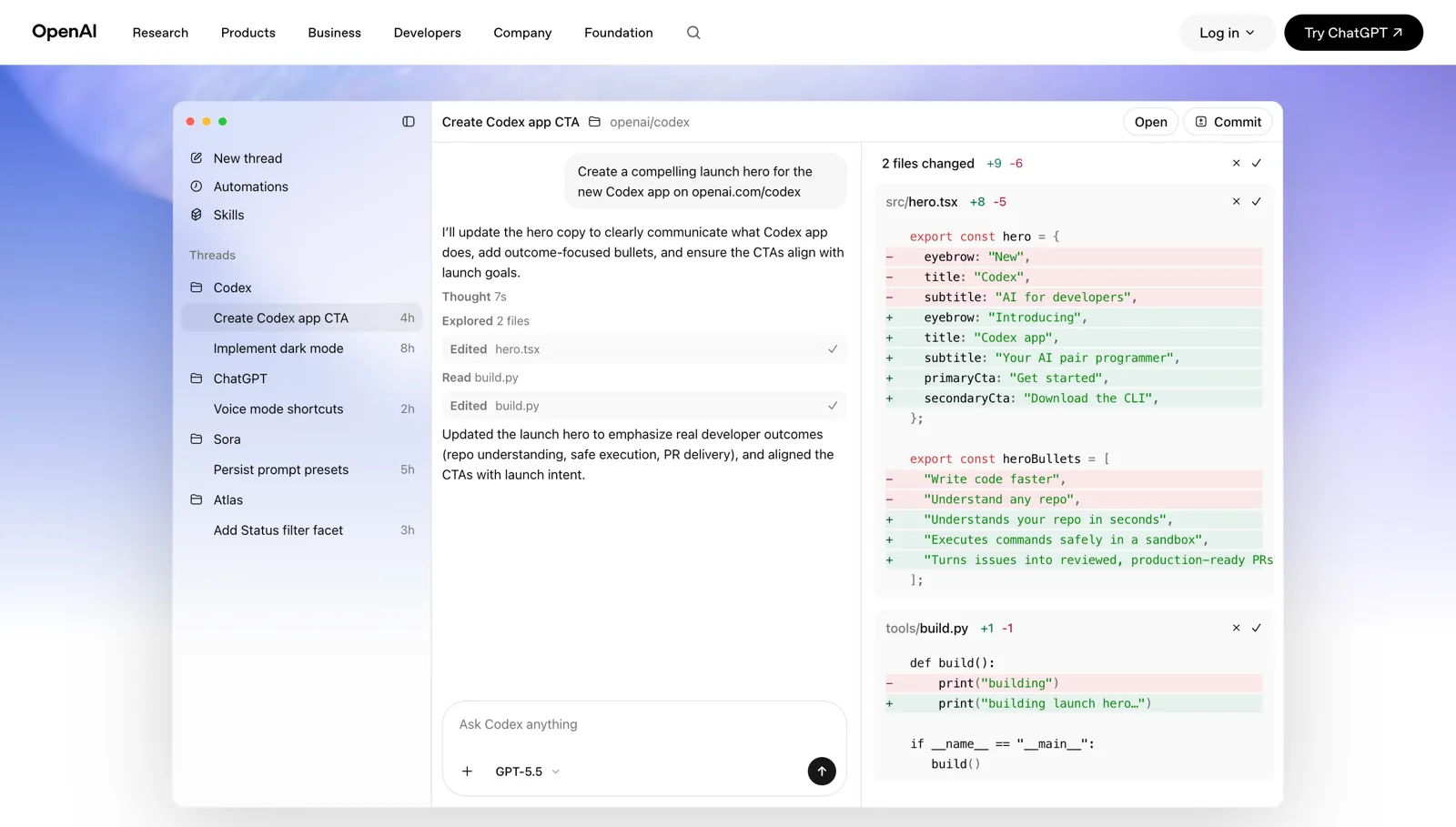
(See OpenAI’s Codex docs for the current surface list; specifics move fast.)
The shorthand: Claude Code’s center of gravity is the session you’re already in, with an async cloud option still finding its footing. Codex spreads its weight more evenly — CLI, app, and a cloud agent that’s had longer to mature.
Agent mode and autonomy
Both tools run the same core loop — read the repo, make changes, run tests, fix what breaks, repeat.
Claude Code runs that loop in whatever terminal or editor you’re in, and shows its work as it goes. You see the commands it runs, the files it edits, and — this is the part that earns trust — it tends to explain a step and ask before doing anything destructive. Running it daily, we’ve watched it stop to ask permission before installing a dependency or touching something it wasn’t sure about. That “narrate, then act” rhythm is the strength of an agent you’re sitting with. It also exposes programmable hooks — scripts that fire on lifecycle events like PreToolUse and PostToolUse — so a team can wire in its own approval gates, formatting, or security checks, and it can fan work out to sub-agents that coordinate on a larger task. A /goal command keeps it working toward a stated objective until it’s met. That’s the terminal/IDE experience; on the research-preview web version, the same agent runs unsupervised in Anthropic’s cloud instead, picking up where you left off across sessions.
Codex can do the same interactive loop through its CLI, but it leans hardest on its cloud agent — the part of Codex that’s had the most time to mature. You describe a task, it spins up a sandbox, works without you watching, and surfaces a pull request for review — and it can run several of those in parallel. It also leans on OS-level sandboxing — running the agent inside the operating system’s own isolation (Seatbelt on macOS, bubblewrap on Linux) rather than just app-layer guardrails, with approval modes that range from auto-approve to confirm-everything. For security-sensitive teams, that OS-level boundary is a real selling point. The net effect is a different model of work: less “pair with the agent,” more “delegate to it and review later.”
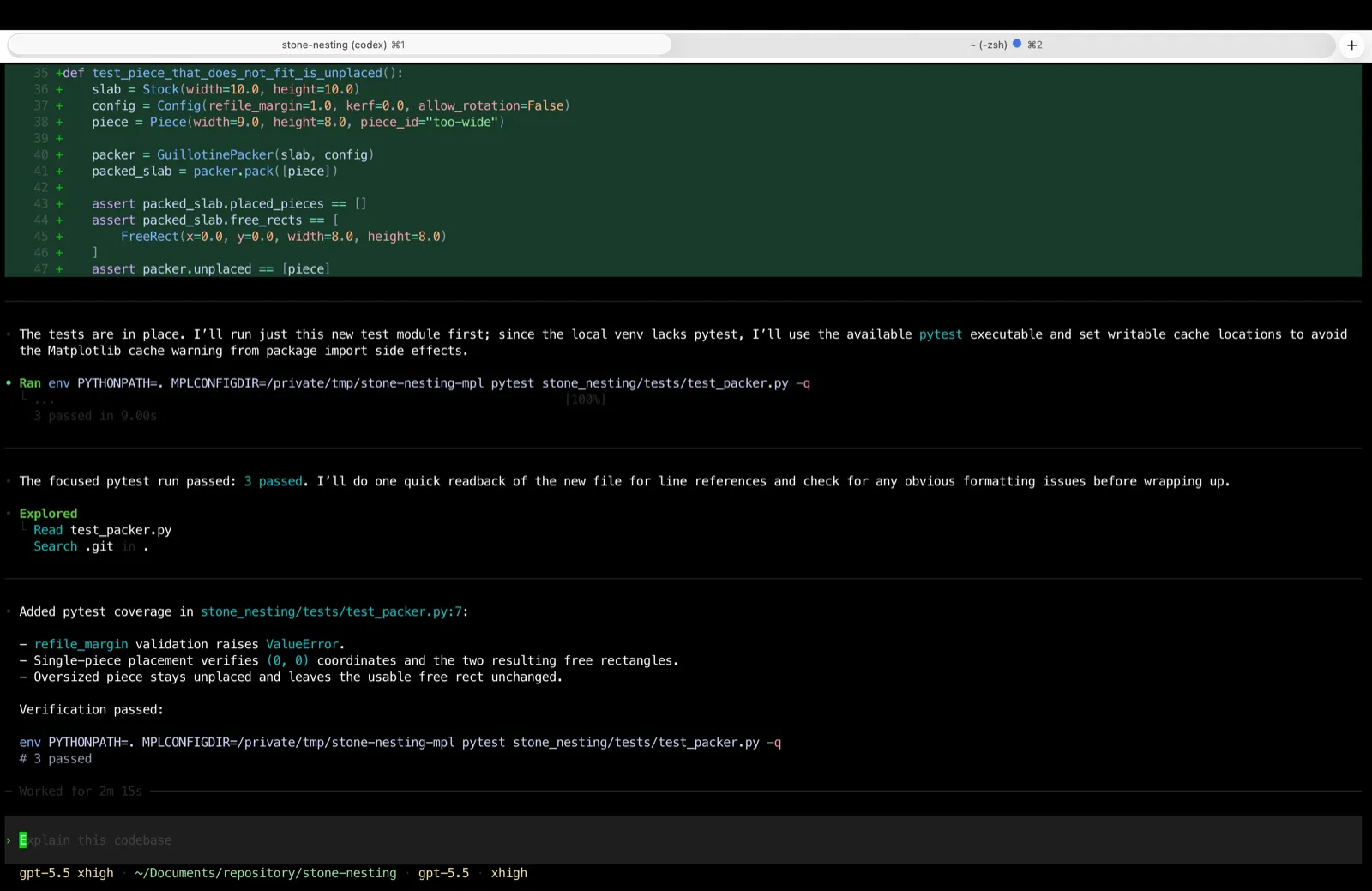
We ran the Codex CLI ourselves, in the same stone-nesting Python project we used for the Claude Code screenshots elsewhere on this site, on gpt-5.5 at its highest reasoning effort (per the CLI’s own status line). Asked to add pytest coverage for an untested packing algorithm, it read the existing code, wrote three test cases — a validation check, a placement check, and an edge case for a piece too large to fit — and ran them itself, confirming 3 passed in 9.00s before reporting back.
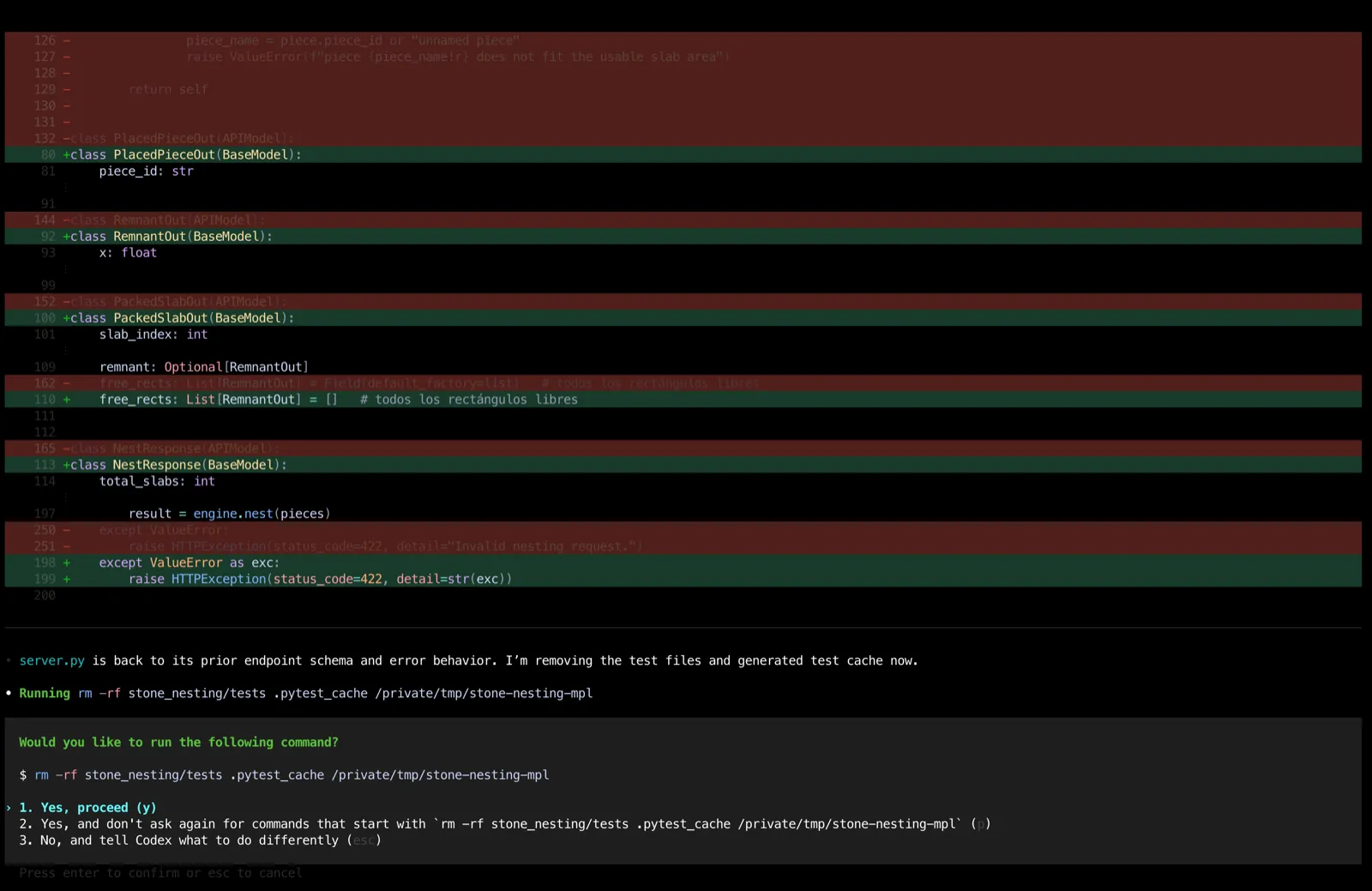
The approval gate showed up later in the same session: when we asked it to revert that change and try a different approach instead, it stopped before running rm -rf to clean up the test files and caches it had created, and waited for an explicit yes rather than deleting anything on its own.
We also tried the cloud agent itself, through the Codex app connected to the same GitHub repo. This is where the async, delegate-and-walk-away model actually showed up: the prompt referenced a file that turned out not to match what we’d intended, and instead of guessing, the agent paused to ask which one we meant before doing any work. Left to run, it picked a real (unrelated) part of the codebase, wrote tests for it, validated them with the project’s own test and lint commands, committed, pushed to a branch, and — because that branch already had an open pull request — updated it automatically, all in just under 7 minutes without anyone watching.
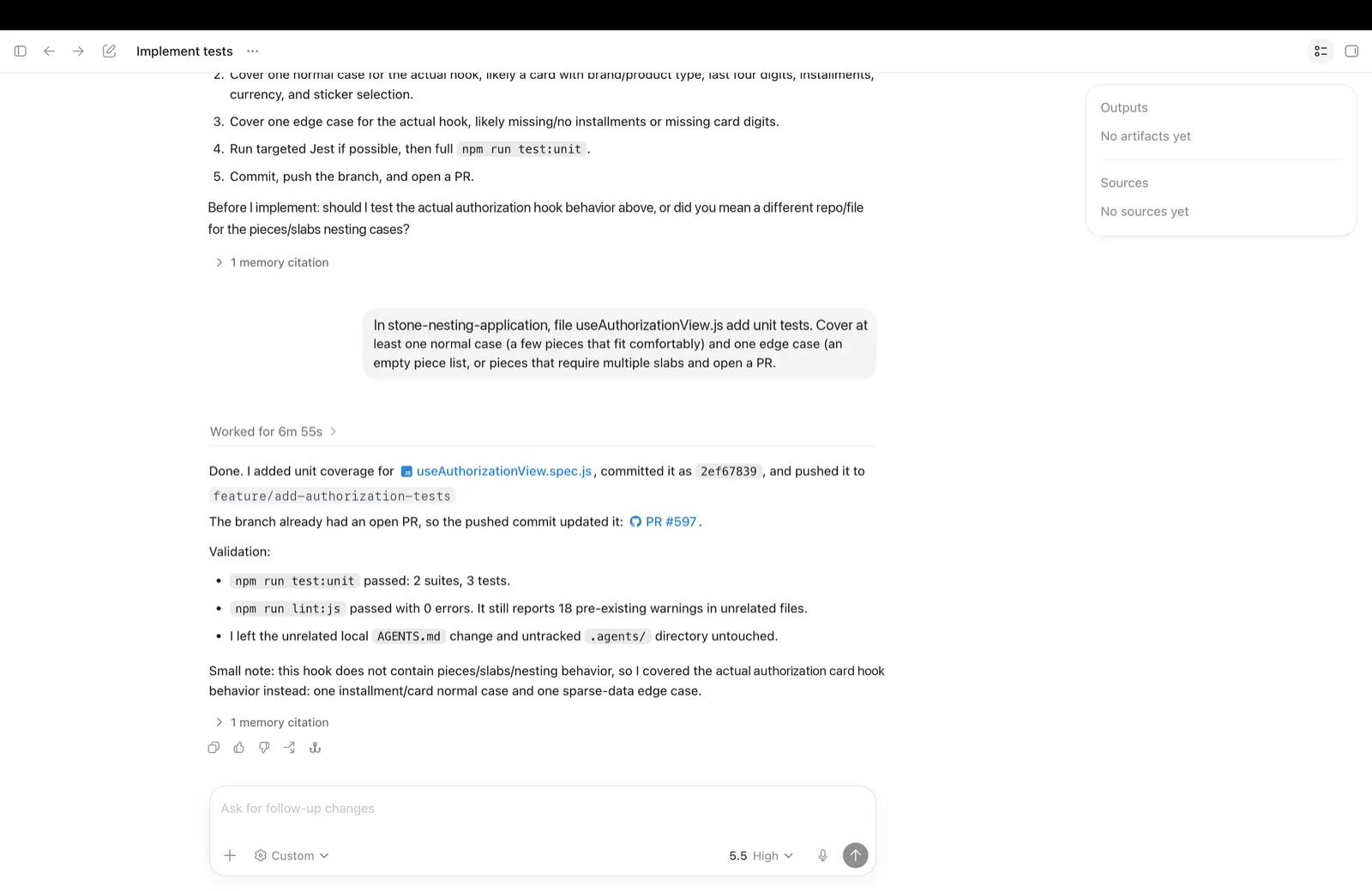
Both tools now do both modes — supervise in real time, or delegate and walk away — so the line isn’t “which one can,” it’s “which one’s delegate mode you’d trust today.” Codex’s cloud agent is generally available and has shipped real PRs in production use for longer; Claude Code’s web version is still labeled research preview. If async, hands-off runs are a workflow you’d lean on heavily, that maturity gap is worth weighing — though it’s the kind of gap that closes fast in this market. (For a closely related head-to-head, see Cursor vs Claude Code — Cursor’s Background Agents play a similar async role.)
Terminal and workflow integration
Claude Code has the edge for terminal-native developers, because the CLI is the product, not a bolt-on:
- Run it inside tmux, Neovim, or any editor’s integrated terminal
- Script it, pipe its output, chain it with other CLI tools
- Use it over SSH on a remote machine without installing an editor
Codex also ships a terminal CLI, so it’s not locked to one editor either — but its design pulls toward the cloud agent and GitHub workflow. If your mental model is “everything happens in a PR,” Codex fits naturally. If it’s “everything happens in my shell,” Claude Code does.
The models underneath
A coding agent is only as good as the model driving it, so the second half of “Claude vs Codex” is really Claude’s lineup against OpenAI’s coding models.
Claude Code runs on Claude models directly. Here’s the current pricing, verified against Anthropic’s pricing:
| Model | Input / 1M | Output / 1M | Context | Best for |
|---|---|---|---|---|
| Claude Fable 5 | $10 | $50 | 1M | Hardest long-horizon work |
| Claude Opus 4.8 | $5 | $25 | 1M | Capable all-rounder |
| Claude Sonnet 5 | $3 | $15* | 1M | Daily interactive coding |
| Claude Haiku 4.5 | $1 | $5 | 200K | High-volume, cheap |
*Sonnet 5 launched with introductory pricing of $2/$10 through August 31, 2026.
Coding is output-heavy, so the output price is the number that drives most bills. Sonnet 5 at $15 is the daily-driver tier, and it’s a stronger one than it used to be — it replaced Sonnet 4.6 on June 30 and picked up a real jump in coding benchmarks in the process. Claude Fable 5 is Anthropic’s strongest coding model on paper — it tops the Terminal-Bench numbers we cite below — and it’s available again after a June 12–July 1 export-control suspension that pulled it for every customer; through July 7, Fable 5 usage counts toward up to 50% of a plan’s weekly limit before switching to usage credits. The 1M-token context window on Sonnet, Opus, and Fable is also a practical edge when you’re feeding a large chunk of a codebase into a single prompt.
Codex runs on OpenAI’s general-purpose flagship models — the GPT-5.6 family (Sol, Terra, Luna) is the default as of August 2026, with GPT-5.5 still available — plus a coding-specialized variant, gpt-5.3-codex, reachable through the API. Here’s the current per-token pricing, verified against OpenAI’s pricing page:
| Model | Input / 1M | Output / 1M | Best for |
|---|---|---|---|
| GPT-5.5 | $5.00 | $30.00 | Codex’s top tier — what we ran in our own test (see above) |
| GPT-5.4 | $2.50 | $15.00 | Lighter, cheaper daily work |
| gpt-5.3-codex | $1.75 | $14.00 | Coding-specialized, API-only |
The output price is again the one that drives the bill: GPT-5.5 at $30 output sits between Claude Sonnet 5 ($15) and Claude Fable 5 ($50), while gpt-5.3-codex — OpenAI’s purpose-built coding model — undercuts everything in this table at $14 output. gpt-5.3-codex and Claude Sonnet 5 land in the same output-price neighborhood ($14 vs $15) and are the comparison most working developers are actually making.
Codex itself (the CLI/app/cloud-agent product, not the raw API) is bundled into ChatGPT’s subscription plans rather than billed per token — see the pricing section below for plan-by-plan limits. For a broader model-by-model look that we have verified, see the best AI models for developers in 2026 and the best LLM for code generation.
How they score on benchmarks
Short version: the public benchmarks don’t cleanly separate these two, and most “X beats Y by N points” headlines don’t survive a look at the method.
The most useful test for a tool comparison is one that scores the agent and the model together, because the same model performs differently inside different agents. Terminal-Bench does exactly that — real terminal tasks run through each tool. On its 2.1 board the two leaders are effectively tied: Claude Code on Claude Fable 5 at 83.8% and Codex CLI on GPT-5.5 at 83.1% — inside each other’s error margins, and both usable today now that Fable 5’s brief suspension has been lifted (see the models section above). If you’d rather stay on Opus 4.8 for cost or speed reasons, it trails at 78.9% on the same board.
SWE-bench Pro (real GitHub issues) is the other common yardstick, and it’s where the headline numbers get slippery. On Scale’s standardized public leaderboard — the version that runs every model through identical scaffolding — the newest models in each tool mostly aren’t submitted yet, and vendor-reported scores use each company’s own scaffold, so they don’t compare to one another. Treat any clean-looking “Claude X% vs GPT Y%” SWE-bench Pro claim with suspicion unless both numbers come from the same board.
The honest takeaway: on the evidence you can actually verify, neither tool has a decisive, current, apples-to-apples lead. Benchmarks are a weak tiebreaker here — your own task on your own codebase tells you more.
Pricing for the tools themselves
Claude Code comes bundled into a Claude Pro subscription — the same plan that gives you Claude on the web and the desktop apps. If you already pay for Pro, Claude Code costs nothing extra; the API is billed separately, pay-as-you-go. Heavy users move up to Claude Max (5× or 20× usage) — the Claude Code page in our pricing tracker keeps the full plan list verified, with price history.
Codex is bundled into ChatGPT’s plans rather than billed per token: Free gives limited access; Go covers lightweight tasks; Plus — the tier comparable to Claude Pro, at the same monthly price — gets you roughly 15–80 local messages on GPT-5.5 per five-hour window (more if you drop to GPT-5.4 or GPT-5.4 mini); Pro raises that to 75–400 messages at 5×, or 300–1,600 at 20×. Business and Enterprise plans scale further, and local CLI use shares the same five-hour window as cloud-agent tasks — the Codex CLI tracker page has the verified plan list. If you’d rather pay per token instead of subscribing, the API gives you direct access to gpt-5.3-codex at $1.75 input / $14 output per million tokens — see the models section above.
The case for Claude Code
- You live in the terminal and want an agent that runs there natively
- You use Vim, Emacs, or a non-VS Code editor, or work over SSH
- You want Claude’s models directly, without a routing layer
- You’re already on Claude Pro and don’t want another subscription
- You prefer to supervise the agent and approve steps as it goes
- You want programmable hooks for approval gates, security checks, or formatting
- You want to try an async cloud agent without leaving Claude — just know it’s research preview, not GA
The case for Codex
- You want to delegate a task to a cloud agent that’s been generally available longer
- Running several agent tasks in parallel is a workflow you’d actually use
- Your team’s work already centers on GitHub pull requests
- You’re already invested in OpenAI’s ecosystem and ChatGPT plans
- You need OS-level sandbox isolation (Seatbelt/
bubblewrap) as a hard requirement
The honest bottom line
There’s no decisive winner, and anyone telling you otherwise is selling something. Claude Code is the better fit if you want to sit with an agent in your terminal and watch it work on Claude’s models. Codex is the better fit if you’d rather hand a task to a cloud agent and get a pull request back, today, with a track record — that’s the workflow we put through its paces above. Claude Code’s own cloud option exists too, it’s just newer and still in research preview. For ordinary day-to-day work — fix this bug, add tests, refactor this function — both produce similar results, because the model matters more than the wrapper.
The deciding question isn’t “which is more capable.” It’s whether your workflow is steering or delegating. Pick the one that matches how you already work, and try your real tasks on it before you commit.
See also: Cursor vs Claude Code · Best AI models for developers in 2026 · AI coding assistants guide · More tool comparisons
Frequently asked questions
What's the difference between Claude Code and Codex?
Claude Code is Anthropic's agent you drive interactively from your terminal or an IDE side panel, running on Claude models directly; it also has a research-preview web version (claude.ai/code) for async, cloud-based runs. Codex is OpenAI's agent that spans an open-source CLI, an IDE extension, GitHub, a chat-style Codex app, and a cloud agent that runs a task in a sandbox and opens a pull request when it's done. Both can now run hands-off in the cloud — Codex's cloud agent is generally available and more battle-tested; Claude Code's is newer and still in research preview.
Is Claude Code or Codex better for coding?
There's no single winner. Claude Code is the pick if you live in the terminal and want Claude's models directly with an explain-then-act loop you watch in real time. Codex is stronger if you want the more mature option for handing a task to a cloud agent that works asynchronously and comes back with a PR — Claude Code's web version does this too, but it's still research preview. Both handle standard agentic work — fix a bug, add tests, refactor a module — well enough that the model and your workflow decide it, not the wrapper.
How much do Claude Code and Codex cost?
Claude Code is included with a Claude Pro plan at $20/month, the same plan that gives you Claude on the web and desktop; API usage is billed separately, pay-as-you-go, and heavy users move up to Claude Max for 5×-20× usage. Codex is bundled into ChatGPT plans: Free is limited, Go and Plus (also $20/month, roughly 15-80 messages on GPT-5.5 per 5-hour window) step up from there, and Pro raises the limits 5x-20x. The pricing snapshots in this comparison and our pricing tracker carry the verified current figures. The API bills per token separately — OpenAI's coding-specialized model, gpt-5.3-codex, runs $1.75 input / $14 output per million tokens.
Does Claude Code have a background cloud agent like Codex?
Yes, now it does — Claude Code on the web (claude.ai/code) connects to GitHub, runs tasks unsupervised on Anthropic's cloud infrastructure, persists sessions even with your browser closed, and can auto-fix a pull request if CI fails or a reviewer comments. It's currently labeled research preview, while Codex's cloud agent has been generally available for longer and is the one we actually tested hands-on for this article. If async, hands-off runs are a workflow you'd lean on heavily, Codex's track record is the safer bet today — but the gap is about maturity, not capability.