Last updated on
Grok vs Gemini vs DeepSeek for developers
Most developer comparisons stop at Claude and GPT-5. But three other models keep coming up — Grok, Gemini, and DeepSeek — and each one wins a specific argument: real-time data, best value, or rock-bottom cost. None of them is the default we’d hand a new developer. All three are worth knowing when the default isn’t the right fit.
Here’s where each one earns its keep.
The quick version
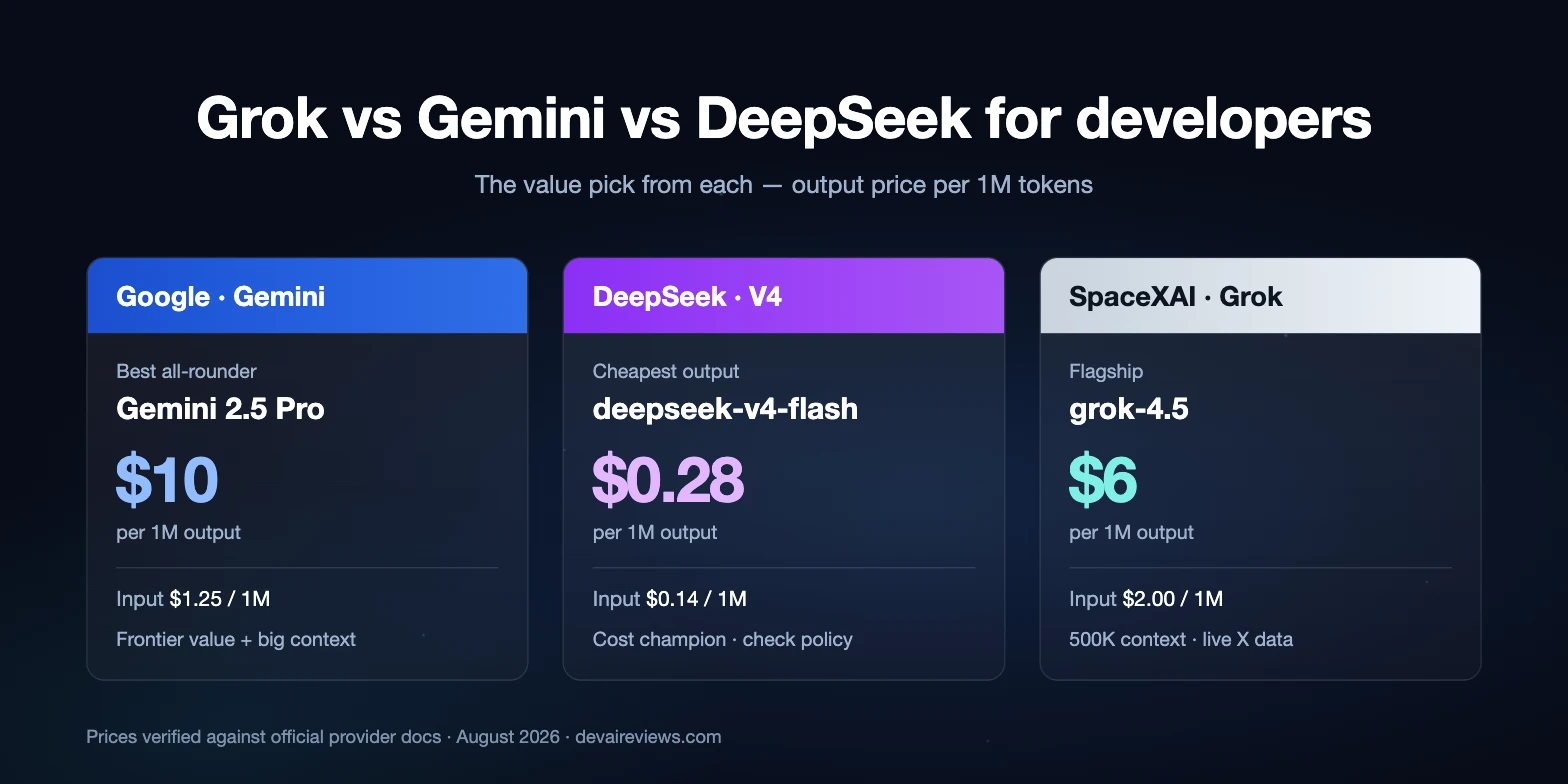
- Gemini is the best all-rounder of the three — frontier-class coding, big context, fair price. The one we’d reach for first.
- DeepSeek is the cost champion on output. That’s the side that drives a coding bill. The trade-off is a non-technical one.
- Grok is the cheapest of the US frontier labs and the only model here with live access to X. A genuine niche, not a daily driver for most.
Google Gemini — the best all-rounder
Gemini is the one of these three that competes at the frontier without a frontier price. Google’s top coding-and-reasoning model is Gemini 3.1 Pro, still in preview, at $2 input / $12 output per million tokens for prompts up to 200K tokens (it steps up to $4 / $18 above that). The newest generally available line is the 3.x Flash family: Gemini 3.6 Flash at $1.50 / $7.50, Gemini 3.5 Flash at $1.50 / $9, and Gemini 3.5 Flash-Lite at $0.30 / $2.50 for high-volume work.
The 2.5 generation is still on the price list and still where a lot of the coding value sits. Gemini 2.5 Pro costs $1.25 / $10, Gemini 2.5 Flash $0.30 / $2.50, and Gemini 2.5 Flash-Lite just $0.10 / $0.40 — the cheapest input rate anyone here charges. Google’s pricing page lists every generation side by side and leaves the choosing to you. Ours: start a coding evaluation on 2.5 Pro unless you need 3.x’s newer search grounding, and note that 3.6 Flash beats 2.5 Pro on output price ($7.50 against $10) while costing more on input. Which is cheaper depends on your token mix, not on the version number.
Two things make Gemini a serious developer option beyond the price. The context windows are large. That matters when you’re generating code against an existing codebase and want to feed real files in rather than summaries. And it’s natively multimodal — useful if your workflow involves screenshots, diagrams, or PDFs alongside code.
The catch is that the tiered pricing has a cliff: cross 200K tokens in a prompt and the rate jumps. For most coding sessions you stay well under that, but if you routinely stuff huge contexts in, price it at the higher tier before you commit.
DeepSeek V4 — the cost champion
DeepSeek is the cheapest usable tier on the side that matters for coding — output. deepseek-v4-pro runs $0.435 input / $0.87 output per million tokens, and deepseek-v4-flash is $0.14 / $0.28. Both carry a 1M-token context window and up to 384K tokens of output. Google undercuts it on input (2.5 Flash-Lite at $0.10), but not on output, where Flash-Lite is $0.40 to DeepSeek’s $0.28 — and code generation is output-heavy, so that’s the number that lands on your bill. At those prices, work that’s expensive elsewhere — running an agent across thousands of tasks, generating code for every file in a large repo — becomes economically routine.
DeepSeek trails the frontier models on the hardest reasoning and agentic tasks, so it’s not where we’d send a gnarly multi-file refactor. For well-scoped, high-volume code generation, the math often wins anyway.
The real consideration with DeepSeek is non-technical. It’s a Chinese provider, and that has data-residency and compliance implications some organizations can’t ignore. Before you point a production workload at the DeepSeek API, check your company’s policy on where proprietary code can be sent. For a side project, it’s a non-issue; for regulated work, it can be a hard stop.
Grok — a cheap frontier model, with a niche
SpaceXAI — the company was still called xAI until the July 2026 rebrand that folded it into SpaceX, though the API host and model IDs didn’t change — ships grok-4.5 as its flagship: $2 input / $6 output per million tokens with a 500K context window, and configurable reasoning. The older grok-4.3 is still on the price list at $1.25 / $2.50 with a full 1M context, which produces the odd situation where the cheaper, older model is the one that takes the bigger prompt. If context size is your binding constraint rather than raw capability, 4.3 is the one to price. SpaceXAI also ships grok-build-0.1, a coding-focused model at $1.00 / $2.00 with a 256K context — the cheapest code-specialized model of the three.
One billing rule deserves a look before you budget. Google charges its higher rate only on the prompts that cross 200K tokens. SpaceXAI applies its long-context rate to every token in a request that crosses that line, including the first one. On grok-4.5 that doubles the request to $4 / $12. The pricing page states it plainly, but it’s easy to skim past.
Grok’s real differentiator isn’t the price, though. It’s live access to data from X. If you’re building something that needs current, real-world signal (monitoring, trend analysis, anything where “what’s happening right now” is the feature), Grok is the only model here wired into that firehose. For ordinary code generation, it’s a capable, cheap option that hasn’t displaced Claude or GPT-5 as a default.
The comparison
| Model | Provider | Input / 1M | Output / 1M | Context | Best for |
|---|---|---|---|---|---|
| Gemini 3.1 Pro (preview) | $2 (≤200K) | $12 (≤200K) | Large | Google’s most capable | |
| Gemini 3.6 Flash | $1.50 | $7.50 | Large | Current GA flagship Flash | |
| Gemini 3.5 Flash-Lite | $0.30 | $2.50 | Large | High-volume 3.x tier | |
| Gemini 2.5 Pro | $1.25 | $10 | Large | Best straight value | |
| Gemini 2.5 Flash | $0.30 | $2.50 | Large | Cheap, fast, routine work | |
| Gemini 2.5 Flash-Lite | $0.10 | $0.40 | Large | Cheapest input rate here | |
| grok-4.5 | SpaceXAI | $2 | $6 | 500K | SpaceXAI’s flagship; live X data |
| grok-4.3 | SpaceXAI | $1.25 | $2.50 | 1M | Cheaper, and the bigger context |
| grok-build-0.1 | SpaceXAI | $1.00 | $2.00 | 256K | Code-leaning, low cost |
| deepseek-v4-pro | DeepSeek | $0.435 | $0.87 | 1M | Capable on a tight budget |
| deepseek-v4-flash | DeepSeek | $0.14 | $0.28 | 1M | Cheapest usable tier |
Both Google and SpaceXAI charge more past 200K tokens, but not the same way. Gemini’s 3.1 Pro goes to $4 / $18 and 2.5 Pro to $2.50 / $15, tiered. SpaceXAI rebills the entire request at its long-context rate — $4 / $12 on grok-4.5, $2.50 / $5 on grok-4.3. Same headline idea, materially different bill.
A note on benchmarks: we don’t print head-to-head SWE-bench numbers for these three because we couldn’t verify comparable scores from a single source. Numbers float around leaderboards using different benchmark variants, and mixing them produces a misleading table. Check each provider’s official model card for its own results, and treat cross-vendor comparisons skeptically unless they name the exact benchmark and variant.
How they stack up against the defaults
The models most US and UK developers default to are Claude and OpenAI’s GPT-5 family. Claude Sonnet 5 ($3 / $15) is the common daily coding driver, and Claude Fable 5 holds the top verified SWE-bench Pro score at 80.3% for the hardest agentic work. None of Grok, Gemini, or DeepSeek has unseated those as the first pick for serious agentic coding.
What these three offer is a reason to look past the default: Gemini if you want frontier value and big context, DeepSeek if cost is the whole game, Grok if you need live data, or a frontier model at half the output price of Gemini’s Pro tier.
The honest take
If you can only try one, try Gemini — it’s the most complete developer option of the three and the least likely to disappoint. Reach for DeepSeek when volume and cost dominate and the code is well-scoped, and your compliance rules allow it. Pick Grok when its live-X-data angle is the actual feature you’re building, or when you want a frontier model at a value price.
And as always, the way to settle it isn’t a pricing table — it’s running your real task on two of them and seeing which writes code you’d ship.
See also: Best AI models for developers in 2026 · Best LLM for code generation in 2026 · all our tool comparisons
Frequently asked questions
Is Grok good for coding?
Grok is capable for everyday coding and priced below the other flagships. grok-4.5 runs $2 input and $6 output per million tokens with a 500K context window; the older grok-4.3 is cheaper at $1.25 / $2.50 and takes a full 1M-token prompt. SpaceXAI also ships grok-build-0.1, a coding-focused model at $1.00 / $2.00. None has displaced Claude or GPT-5 as the default for hard agentic work, but the price-to-capability ratio is strong.
Which is cheaper, Gemini or DeepSeek?
It depends which side of the bill you mean. Gemini 2.5 Flash-Lite is cheaper on input at $0.10 per million tokens against deepseek-v4-flash's $0.14, but DeepSeek is cheaper on output — $0.28 against $0.40 — and coding workloads are output-heavy, so DeepSeek usually wins the real comparison. Gemini buys you Google-scale infrastructure, larger verified context handling, and multimodal input for the difference.
Should developers use DeepSeek?
For cost-sensitive, high-volume work where the code is well-scoped, DeepSeek V4 is hard to beat on price. The caveat is non-technical: DeepSeek is a Chinese provider, so check your organization's data-residency and compliance rules before sending proprietary code to its API.
Grok vs Gemini vs DeepSeek — which is best for developers?
It depends on the constraint. Gemini is the best all-round value, with frontier-class coding and large context at a fair price. DeepSeek wins on raw cost. Grok is the cheapest of the US frontier labs and the pick if real-time data from X matters to your app. For most developers, none of the three is the first choice over Claude or GPT-5 — they earn their place on specific jobs.