Last updated on
Best AI models for developers in 2026
There’s no single “best AI model for developers” in 2026, and any article that gives you one name is selling something. The honest answer is that the right model depends on three things: how hard your task is, how many requests you’ll run, and whether a human is waiting for the response. Get those straight and the choice mostly makes itself.
Here’s the short version, then the detail behind it.
The quick verdict
- Best overall for coding: Claude Fable 5 — highest agentic-coding scores, but slow and expensive, so use it for hard async work, not chat.
- Best daily driver: Claude Sonnet 5 or GPT-5.4 — fast, capable, and priced for everyday interactive coding.
- Best value: Google Gemini 2.5 Pro — frontier-class coding at $1.25/$10 per million tokens, though output-heavy workloads should price 3.6 Flash at $1.50/$7.50 first.
- Cheapest that’s still good: DeepSeek V4 — output at well under a dollar per million tokens.
- Cheapest flagship to experiment with: SpaceXAI’s Grok — grok-4.5 at $2/$6, or the older grok-4.3 at $1.25/$2.50, with free credits to start (check the data-sharing terms; some regions are excluded).
The rest of this guide is how to think about that table instead of just trusting it.
How model pricing actually works
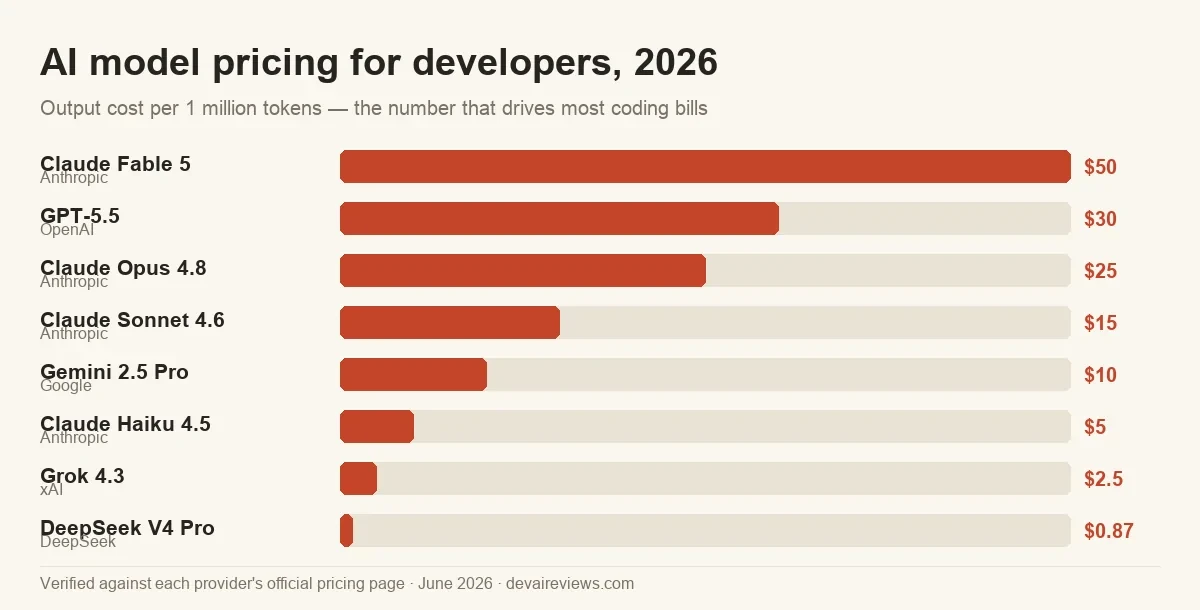
Every API charges separately for input tokens (the prompt you send, including any code and context) and output tokens (what the model writes back). Output is almost always the expensive side — often 4 to 5 times the input rate — and most coding workloads are output-heavy. So when you compare models, the output price is the number that drives your bill.
A token is roughly 4 characters of English, or about ¾ of a word. A medium coding prompt with a few files of context might be 10,000–30,000 input tokens; a substantial response with explanation and code might be 2,000–8,000 output tokens. Multiply by your request volume and the per-million-token prices below stop looking abstract fast.
The spread is enormous. Claude Fable 5’s output costs roughly 57 times what DeepSeek V4 Pro’s does. That gap isn’t a scam on either end — they’re built for different jobs. Fable 5 is for the hardest problems run in the background; DeepSeek is for high-volume work where good-enough at a fraction of the cost wins.
The models, by provider
Anthropic — Claude
Anthropic’s lineup is the one to beat on agentic coding, which is the benchmark that matters most for developers: can the model read a real repository, find the bug, and ship a working fix?
- Claude Fable 5 (
claude-fable-5) — $10 / $50 per million tokens. The flagship, released June 2026. It scores 80.3% on SWE-bench Pro, the highest of any current model on that benchmark. The catch is speed: a task Opus finishes in seconds can take Fable 5 a minute or more, and a multi-step agentic run can run for tens of minutes. It’s built for “hand it a whole task and come back,” not interactive chat. - Claude Opus 5 (
claude-opus-5) — $5 / $25. Released July 24, 2026 and now Anthropic’s recommended Opus tier for coding, at the same price as Opus 4.8, which it supersedes. Independent coding benchmarks are still landing — see our Claude Opus 5 explainer. - Claude Opus 4.8 (
claude-opus-4-8) — $5 / $25. The previous-generation Opus, 69.2% on SWE-bench Pro, with a fast mode that makes it practical for real-time work. - Claude Sonnet 5 (
claude-sonnet-5) — $3 / $15 ($2/$10 introductory pricing through August 31, 2026). The model most developers should default to, and the one that improved the most in Anthropic’s June 30 update — SWE-bench Pro jumped from 58.1% to 63.2%. Fast enough for interactive coding, strong enough for real tasks, and a fraction of flagship cost. - Claude Haiku 4.5 (
claude-haiku-4-5) — $1 / $5. The cheap, fast tier for high-volume work like classification, summarization, and quick completions.
Fable 5, Opus, and Sonnet all carry a 1M-token context window; Haiku is 200K. If code generation is your main use, our best LLM for code generation ranks them for exactly that.
OpenAI — GPT-5
OpenAI’s current generation is the GPT-5 family, and it’s priced more aggressively than the Claude flagship.
- gpt-5.5 — $5 / $30 per million tokens. The latest flagship.
- gpt-5.4 — $2.50 / $15. The previous generation, and a strong daily-driver price for its capability.
- gpt-5.4-mini — $0.75 / $4.50. The budget tier for high-volume tasks.
- gpt-5.3-codex — $1.75 / $14. A coding-specialized model, the one to reach for if your workload is mostly code generation and editing rather than general reasoning.
The codex variant is the interesting one for developers: a model tuned for coding at a price between the mini and the flagship. If you’ve been defaulting to the flagship for code, the codex model is usually the better cost-to-quality pick.
Google — Gemini
Google’s Gemini line is the value play. You get frontier-class coding without the flagship price tag, plus the largest context windows in common use.
- Gemini 3.1 Pro (
gemini-3.1-pro-preview) — $2 / $12 per million tokens for prompts up to 200K, rising to $4 / $18 above that. Google’s top coding-and-reasoning model, still in preview. - Gemini 3.6 Flash (
gemini-3.6-flash) — $1.50 / $7.50. The newest generally available Flash, and cheaper on output than 3.5. - Gemini 3.5 Flash (
gemini-3.5-flash) — $1.50 / $9. Same input price as 3.6, $1.50 more per million on output. - Gemini 3.5 Flash-Lite (
gemini-3.5-flash-lite) — $0.30 / $2.50. The 3.x tier for high-volume agentic work and simple data processing. - Gemini 2.5 Pro (
gemini-2.5-pro) — $1.25 / $10. Still excellent for coding, and the best straight value in the table. - Gemini 2.5 Flash (
gemini-2.5-flash) — $0.30 / $2.50. Cheap, fast, and fine for routine work, with a 1M-token context window. - Gemini 2.5 Flash-Lite (
gemini-2.5-flash-lite) — $0.10 / $0.40. The cheapest input rate of any model in this guide.
Read that list as a menu, not a ladder. Google keeps three generations live at once, and version numbers don’t sort by price: 3.6 Flash is $1.50 / $7.50 against 2.5 Pro’s $1.25 / $10, so 2.5 Pro is cheaper to prompt and more expensive to listen to. Work out your own input-to-output ratio, then check the official pricing table — that ratio decides the winner, not the release date.
If budget is a real constraint but you don’t want to drop to a discount provider, Gemini 2.5 Pro at $1.25/$10 is the model we’d point most teams toward first.
SpaceXAI — Grok
Grok’s pitch is price and free credits. The flagship is cheap by flagship standards, and SpaceXAI — xAI’s name since the July 2026 rebrand that merged it into SpaceX, with the API host and model IDs unchanged — hands every developer a meaningful pile of free credits to start.
- grok-4.5 — $2 / $6 per million tokens, 500K context, configurable reasoning. The current flagship.
- grok-4.3 — $1.25 / $2.50, and a full 1M context. Cheaper than the flagship that replaced it, and it takes the larger prompt.
- grok-build-0.1 — $1.00 / $2.00, with a 256K context window. The coding-focused variant.
Watch the 200K line. Cross it and SpaceXAI charges its long-context rate on the entire request, not on the overflow alone — $4 / $12 for grok-4.5, $2.50 / $5 for grok-4.3, per the pricing page. Google, by comparison, only reprices the prompts that cross its own threshold.
SpaceXAI also offers free API credits through a data-sharing program, which makes Grok a low-friction way to run real experiments. The amount and eligibility vary — some regions are excluded — so read the data-sharing terms on the SpaceXAI console before you rely on it or route production code through it.
DeepSeek — V4
DeepSeek is the budget end of the table, and it’s not close. Its V4 generation replaced the older V3 and R1 models in 2026.
- deepseek-v4-pro — $0.435 / $0.87 per million tokens (standard input, cache miss). The capable tier.
- deepseek-v4-flash — $0.14 / $0.28. The economical tier, with aggressive cache-hit discounts that drop input to fractions of a cent.
At these prices, DeepSeek changes what’s economically possible: workloads that would be unaffordable on a flagship — processing every file in a large repo, running an agent across thousands of tasks — become routine. The trade-off is that it sits behind the frontier models on the hardest reasoning and agentic-coding tasks. For high-volume, well-scoped work, that trade is often worth it.
The full comparison
| Model | Provider | Input / 1M | Output / 1M | Context | Best for |
|---|---|---|---|---|---|
| Claude Fable 5 | Anthropic | $10 | $50 | 1M | Hardest async agentic coding |
| GPT-5.5 | OpenAI | $5 | $30 | — | Top-tier general + coding |
| Claude Opus 5 | Anthropic | $5 | $25 | 1M | Current Opus tier for coding |
| Claude Opus 4.8 | Anthropic | $5 | $25 | 1M | Previous-gen Opus, fast mode |
| Claude Sonnet 5 | Anthropic | $3 | $15 | 1M | Daily interactive coding |
| GPT-5.4 | OpenAI | $2.50 | $15 | — | Strong daily driver |
| gpt-5.3-codex | OpenAI | $1.75 | $14 | — | Code-specialized work |
| Gemini 3.1 Pro | $2 | $12 | large | Value frontier coding | |
| Gemini 2.5 Pro | $1.25 | $10 | large | Best straight value | |
| Gemini 3.6 Flash | $1.50 | $7.50 | large | Newest GA Flash tier | |
| grok-4.5 | SpaceXAI | $2 | $6 | 500K | SpaceXAI’s flagship |
| Claude Haiku 4.5 | Anthropic | $1 | $5 | 200K | High-volume, low-latency |
| grok-4.3 | SpaceXAI | $1.25 | $2.50 | 1M | Cheap, and the bigger context |
| DeepSeek V4 Pro | DeepSeek | $0.435 | $0.87 | — | Capable on a tight budget |
| DeepSeek V4 Flash | DeepSeek | $0.14 | $0.28 | — | Cheapest usable tier |
Context-window and exact output-ceiling figures vary by provider and change often. Confirm the current numbers on each provider’s docs before you architect around them.
How to choose, in practice
Forget “which model is best” and answer four questions about your actual workload.
Is a human waiting for the answer? If yes, latency rules. A developer staring at a spinner needs Sonnet 5, GPT-5.4, or a Flash-tier Gemini — models that respond in seconds. Save Fable 5 and the heavy reasoning models for work that runs in the background.
How hard is the task? Short completions, boilerplate, and well-defined edits don’t need a flagship. A mid-tier or budget model handles them at a fraction of the cost. Reserve the expensive models for genuinely hard problems: large migrations, deep cross-file debugging, long agentic runs.
How many requests will you run? At ten requests a day, price barely matters — pick on quality. At a million requests a day, the output price is your architecture. That’s the point at which DeepSeek or a Flash tier stops being a compromise and starts being the only sane choice.
Do you need to send a huge amount of context? If you’re feeding entire codebases into a single prompt, the 1M-token context models — Claude and Gemini — are the ones that fit. Most models top out lower.
The pattern that works for most teams isn’t picking one model. It’s routing: a cheap fast model for the common case, a flagship for the hard case, and a budget model for the high-volume background jobs. The providers above each win a different one of those slots.
Best model for each job
Best for autonomous agents: Claude Fable 5. The highest agentic-coding scores, and explicitly built to run a long task to completion on its own. Pair it with cheaper models for the steps that don’t need it.
Best for interactive coding in your editor: Claude Sonnet 5 or GPT-5.4. Fast, capable, and priced so you won’t think twice about leaving them on all day.
Best for code-specialized workloads: gpt-5.3-codex. A model tuned for coding at a mid-tier price.
Best value: Gemini 2.5 Pro. Frontier-class coding at $1.25/$10.
Best on a tight budget: DeepSeek V4. Output under a dollar per million tokens, capable enough for most well-scoped work.
Best for experimenting free: Grok, on its free data-sharing credits (check eligibility).
We test these models on real coding tasks and publish the detail in focused comparisons. For code specifically, our best LLM for code generation ranks the shortlist. If you’re choosing a tool rather than a raw model, our guide to AI coding assistants covers the editors and agents that run on top of these models.
Frequently asked questions
What is the best AI model for coding in 2026?
For raw agentic-coding ability, Claude Fable 5 leads on SWE-bench Pro at 80.3%. But the best model depends on the job — for fast interactive coding most developers are better served by Claude Sonnet 5 or GPT-5.4, and for value Gemini 2.5 Pro is hard to beat.
Is GPT-5 better than Claude for development?
They trade blows. Claude leads on published agentic-coding benchmarks, while OpenAI prices its GPT-5 flagship more aggressively and offers a coding-specialized gpt-5.3-codex model. The right pick depends on whether you weight benchmark scores or cost.
What is the cheapest AI model that is actually good for code?
DeepSeek V4 Flash at $0.14 input and $0.28 output per million tokens is the cheapest on output, which is what drives a coding bill. Gemini 2.5 Flash-Lite undercuts it on input at $0.10 but charges $0.40 on output. Both handle routine and high-volume coding well, though they sit behind the flagships on the hardest tasks.
Do I have to pick just one model?
No, and most teams should not. Routing requests — a cheap model for common cases, a flagship for hard ones, and a budget model for high-volume background jobs — beats committing to a single model on both cost and quality.
How current are these prices?
They were verified against each provider's official pricing page in August 2026. Model lineups and prices change frequently, so always confirm on the provider docs before committing.