Claude Opus 5: what's new, pricing, and how it compares
Anthropic shipped Claude Opus 5 today, July 24, 2026. The headline for developers is the pricing: it lands at the exact same per-token cost as Claude Opus 4.8, which it now replaces as Anthropic’s go-to model for coding. Same bill, a model Anthropic says is meaningfully more capable. We haven’t run it through our own tests yet, so this is a first look at what changed and where it fits — not a hands-on verdict.
Key takeaways:
- Price is unchanged: $5 / $25 per million tokens, the same as Opus 4.8 — which moves to Anthropic’s legacy line.
- Same specs as 4.8: a 1M-token context window and 128K max output. The API model string is
claude-opus-5. - Anthropic claims a large jump in coding and knowledge work over Opus 4.8 — but those are the vendor’s own benchmarks, not independent results.
- We haven’t tested it yet. This is a first look from the announcement and verified pricing; a hands-on follow-up comes later.
What is Claude Opus 5?
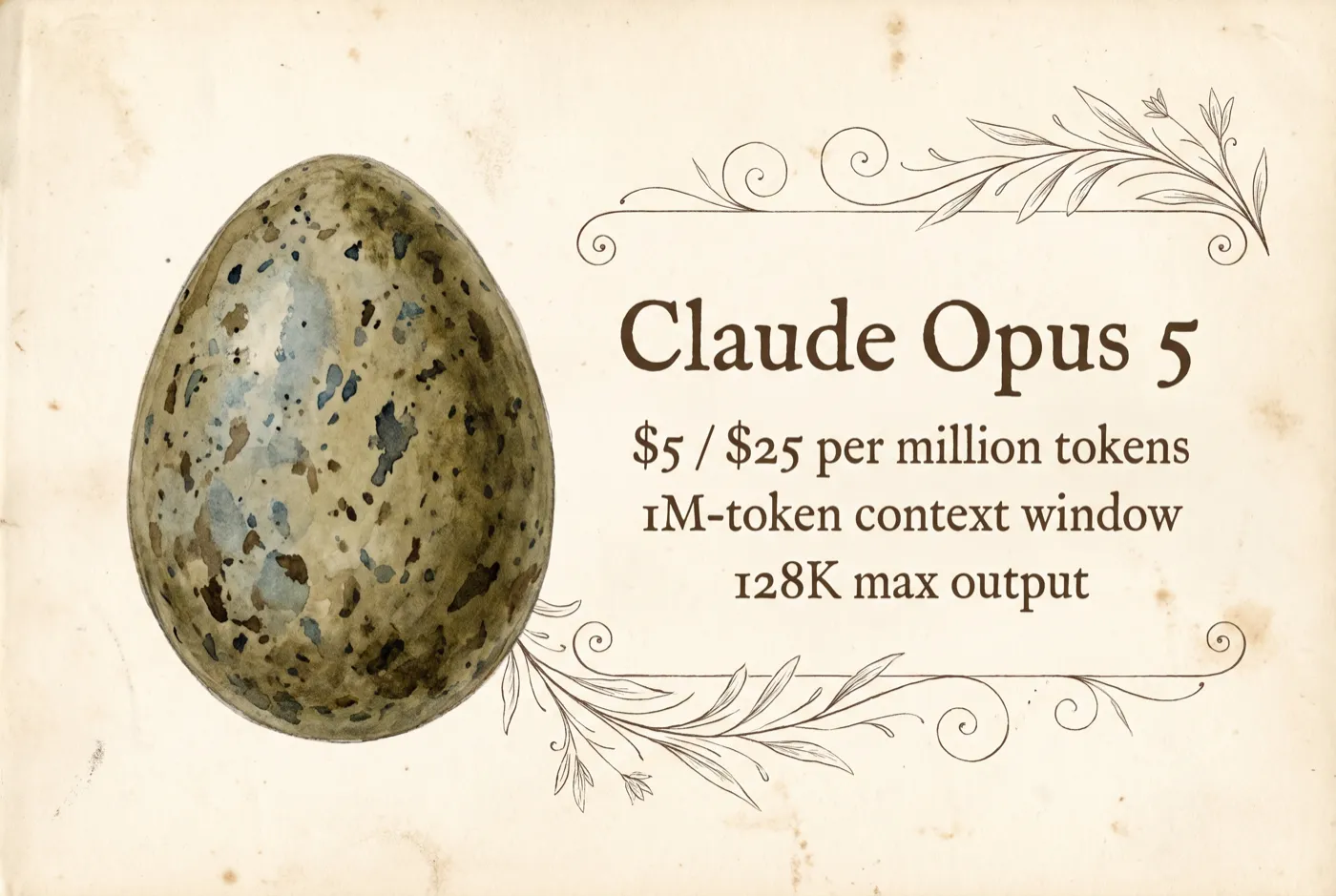
Claude Opus 5 is Anthropic’s new Opus-tier model, positioned for complex agentic coding and enterprise work. On the Claude API you call it with the model string claude-opus-5. It carries a 1 million–token context window, returns up to 128K output tokens in a single response, and has a knowledge cutoff of May 2026 — a few months fresher than the Opus 4.x line.
Anthropic’s own docs now tell developers to start with Opus 5 for coding, with Claude Fable 5 reserved for the workloads that need the absolute highest capability. In other words, Opus 5 is the new sensible default, and Opus 4.8 has moved to the legacy list.
What changed from Opus 4.8
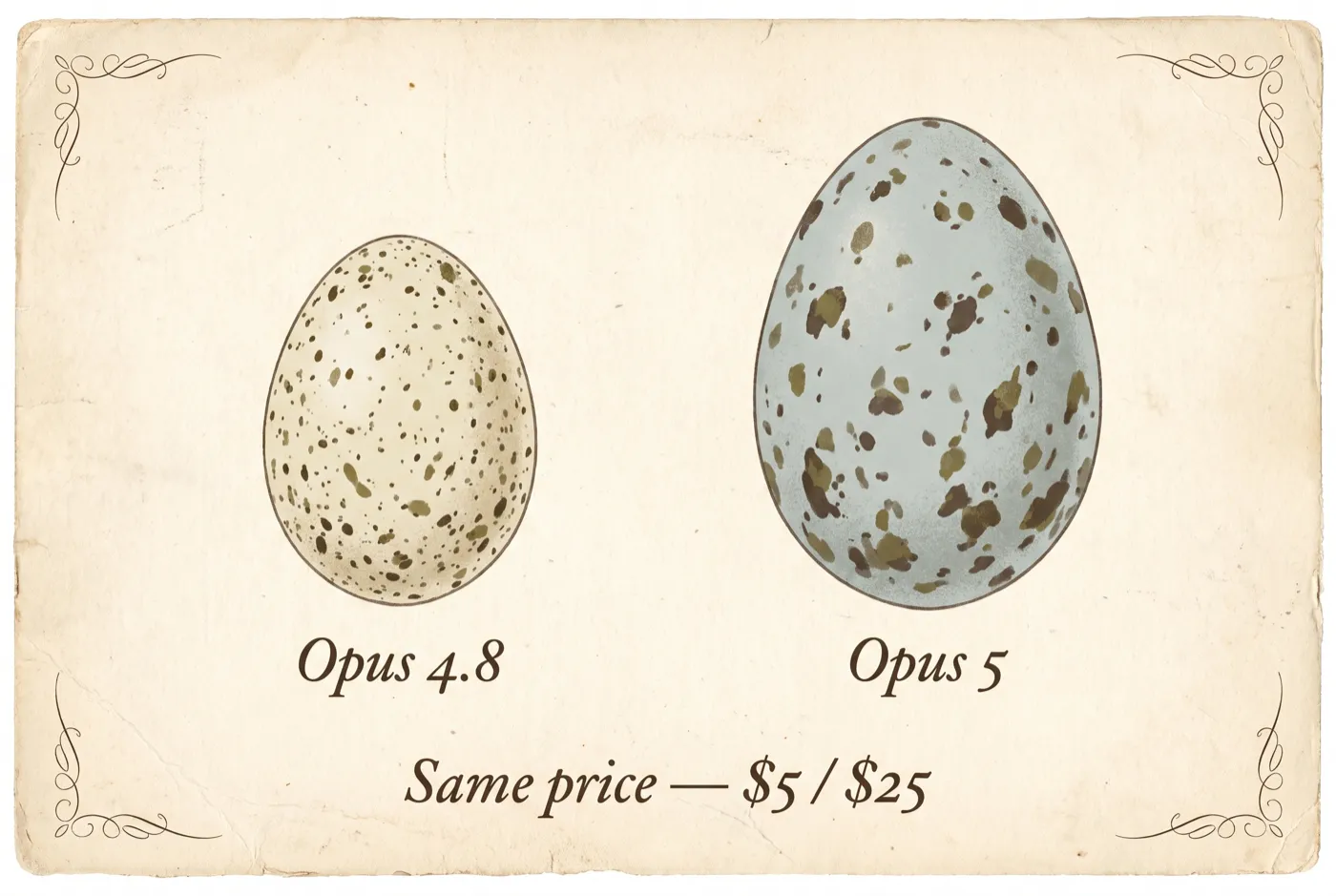
The clearest change is the value math. Opus 5 is priced identically to Opus 4.8 ($5 in / $25 out per million tokens) while Anthropic claims a large capability jump on top.
From the launch announcement, the numbers it leads with:
- On its own coding benchmark, Opus 5 “more than doubles Opus 4.8’s performance at a lower cost per task.”
- On a Cursor-based coding eval at maximum effort, it lands within 0.5% of Fable 5’s peak score at roughly half the cost.
- On knowledge and reasoning evals, Anthropic reports gains over the next-best model, plus jumps of 10.2 and 7.7 percentage points over Opus 4.8 on organic-chemistry and protein-function tasks.
Treat those as Anthropic’s marketing numbers, not independent results. They come from the vendor, some of the benchmark names are new, and we haven’t reproduced any of them. What we can say plainly: the price didn’t move, so trying Opus 5 on your own code carries no extra cost versus the 4.8 you’re probably already paying for.
On safety, Anthropic calls Opus 5 its “most aligned model to date” and notes it still sits behind its restricted Mythos 5 model on biology research and offensive-cybersecurity capability — a deliberate line, not a gap.
How much does Claude Opus 5 cost?
Here’s where Opus 5 sits against the models around it, per million tokens on the Claude API:
| Model | Context | Max output | Input / 1M | Output / 1M |
|---|---|---|---|---|
| Claude Fable 5 | 1M | 128K | $10 | $50 |
| Claude Opus 5 | 1M | 128K | $5 | $25 |
| Claude Opus 4.8 | 1M | 128K | $5 | $25 |
| Claude Sonnet 5 | 1M | 128K | $3 | $15* |
*Sonnet 5 is on introductory pricing of $2/$10 through August 31, 2026.
The specs match Opus 4.8 exactly — same context window, same output ceiling, same price. There’s also a fast mode: the same model at roughly 2.5x the output speed for twice the base price, for latency-sensitive work where you’ll pay for the speed. Prices are from Anthropic’s model pricing, verified July 24, 2026.
How to use it
On the Claude API, swap the model string to claude-opus-5 and the rest of your Messages API code stays the same. A minimal TypeScript call:
import Anthropic from "@anthropic-ai/sdk";

const client = new Anthropic(); // reads ANTHROPIC_API_KEY from the environment

const response = await client.messages.create({
  model: "claude-opus-5",
  max_tokens: 16000,
  messages: [
    { role: "user", content: "Refactor this module and explain the trade-offs." },
  ],
});

for (const block of response.content) {
  if (block.type === "text") console.log(block.text);
}
Two behaviors to know before you wire it in:
- Adaptive thinking, defaulting to high effort. On the API and in Claude Code, the
effortparameter defaults tohigh. Set it explicitly (lowthroughmax) to trade depth against latency and token spend. - No fixed thinking budget. Like the rest of the recent Claude line, Opus 5 uses adaptive thinking rather than a
budget_tokensvalue — you steer witheffort, not a token count.
Beyond the API, Opus 5 is available today in Claude Code, on claude.ai, and in Claude Cowork. It’s the default model on Claude Max and the strongest option on Claude Pro, so most people on a paid plan are already one model-picker click away from it.
Should you switch?
If you’re on Opus 4.8, the switch is low-risk: the price is the same and the model string is a one-word change. The sensible move is to point one real task at claude-opus-5 and judge the output yourself rather than trust the launch benchmarks either way.
We haven’t put Opus 5 through our own long-horizon coding tests yet — everything above is from Anthropic’s announcement and verified pricing, not a hands-on run. We’ll follow up with real results and how it stacks up against the tools we already cover. For the wider picture on model choice, see our Claude Opus 4.8 review and our comparison of the Claude models.
See also: Best AI models for developers in 2026 · Best LLM for code generation · More developer guides
Frequently asked questions
What is Claude Opus 5?
Claude Opus 5 is Anthropic's new Opus-tier model, released July 24, 2026 and aimed at complex agentic coding and enterprise work. On the Claude API you call it with the model string claude-opus-5. It has a 1 million-token context window, up to 128K output tokens, and adaptive thinking that's on by default.
How much does Claude Opus 5 cost?
On the Claude API, $5 per million input tokens and $25 per million output tokens — the same per-token price as Claude Opus 4.8, which it replaces as Anthropic's recommended default. A fast mode runs at roughly 2.5x the speed for twice the base price.
Is Claude Opus 5 better than Opus 4.8?
Anthropic says Opus 5 more than doubles Opus 4.8's performance on its own coding benchmark at a lower cost per task, and posts gains on knowledge work and life-sciences evals. Those are Anthropic's own numbers, not independent tests — but since Opus 5 costs the same per token as 4.8, there's little reason not to try it on your own work.
Where can I use Claude Opus 5?
It's available today on the Claude API, in Claude Code, on claude.ai, and in Claude Cowork. It's the default model on the Claude Max plan and the strongest option on Claude Pro.