Last updated on
Claude Opus 4.8 review: what the effort dial buys you
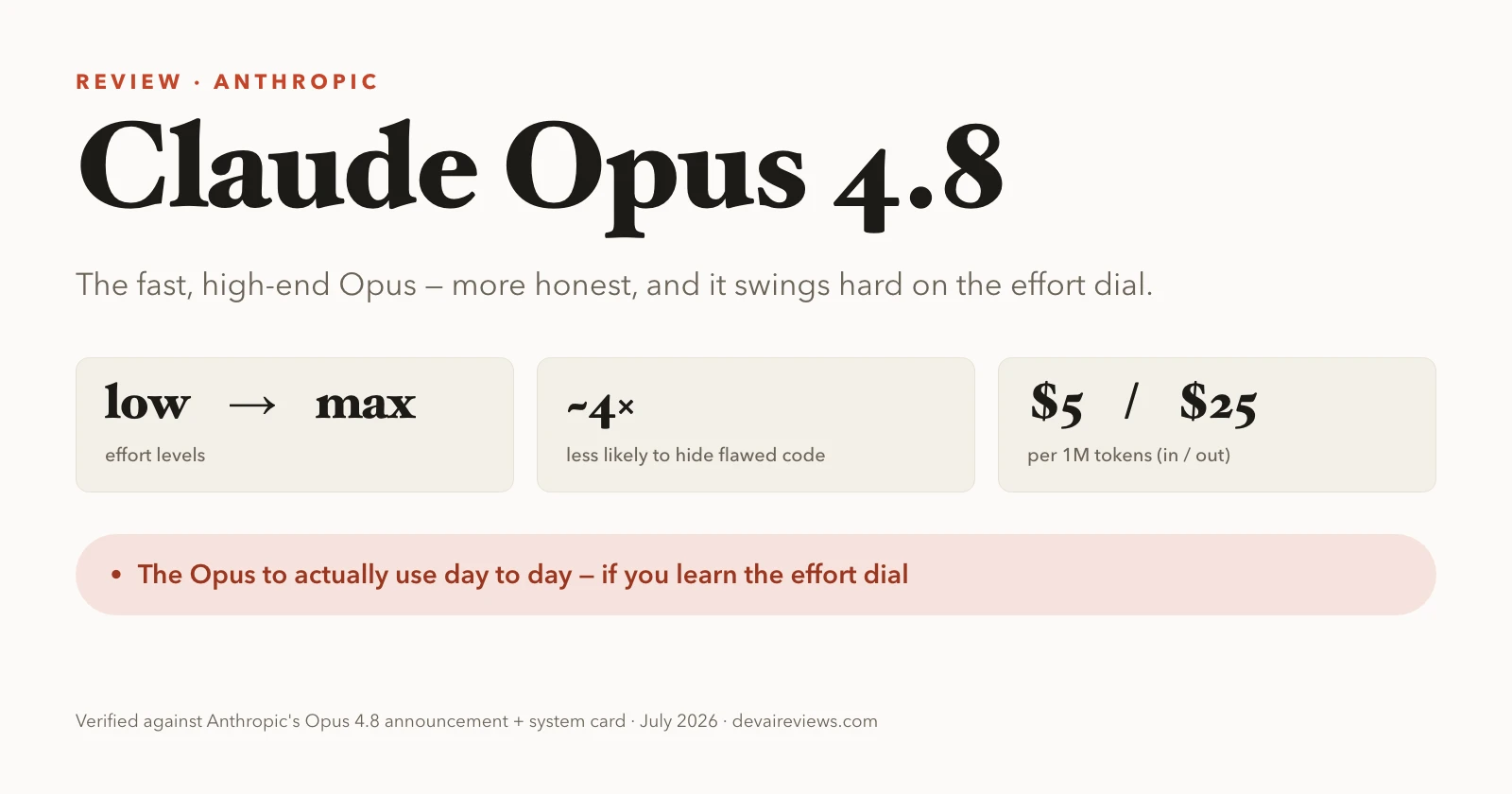
The short version: Claude Opus 4.8 is the model most developers should actually be using day to day, and its single most important trait isn’t a benchmark score — it’s that it’s more honest about its own work. It’s fast, it’s the tier Anthropic builds its real-time experiences on, and its output quality swings more with the effort setting than any Claude before it. Learn the dial and it’s excellent. Ignore the dial and you’ll either overpay or underwhelm.
That’s the whole review in a paragraph. Here’s where the judgment comes from — including where we run it ourselves.
What’s new in Opus 4.8
Update (July 24, 2026): Anthropic has since released Claude Opus 5. It takes over as the current Opus-tier model at the same $5/$25 price. This review covers Opus 4.8, still available; for what’s new in its successor, see our Claude Opus 5 explainer.
Opus 4.8 (claude-opus-4-8) is Anthropic’s fast, high-end Opus-tier model, launched May 28, 2026, and the upgrade over Opus 4.7 is more about judgment than raw horsepower (Anthropic’s announcement). Three changes matter.
It’s more honest. This is the headline, and it’s the right one. Anthropic says Opus 4.8 is roughly four times less likely than 4.7 to finish a coding task and quietly not mention that the code is broken. In practice that shows up as a model that tells you when it’s unsure, flags its own mistakes, and stops declaring victory after one clean run. For anyone shipping code an agent wrote, a model that admits “this might be wrong” is worth more than one that’s a hair smarter and confidently silent.
Effort controls. Opus 4.8 exposes an effort setting that scales how hard it thinks and acts. On the API that’s low, medium, high, xhigh, and max; in claude.ai and Cowork it’s a control next to the model picker. This is the single biggest lever on the model, and it gets its own section below.
A cheaper fast mode. Fast mode runs the same model at up to 2.5x the output speed for a premium, and Anthropic says the 4.8 premium is about three times cheaper than it was on earlier Opus models. Alongside the model, Anthropic also shipped dynamic workflows in Claude Code — a research preview that plans a large task and runs many parallel subagents in one session — for Enterprise, Team, and Max plans.
The effort dial is the whole story
If you take one thing from this review: on Opus 4.8, the effort level decides whether you get a careful fixer or a senior engineer, and the gap is large. We see the swing firsthand: the same model at a low effort setting patches surface problems, and at a high one restructures the system when it needs to.
In Claude Code, the /effort picker lays the levels out on a scale from Faster to Smarter: low, medium, high, xhigh, and max, plus ultracode (xhigh with dynamic workflow orchestration on top).

Here’s how we think about the levels for real work:
| Effort | Reach for it when |
|---|---|
high (default) |
Most intelligence-sensitive work. Best balance of quality and token spend — start here. |
xhigh |
Hard coding and agentic tasks. It's what Claude Code runs by default, and where 4.8 does its best architectural work. |
max |
Problems where correctness beats cost. Powerful, but prone to overthinking — and on very long tasks it can underperform high. |
low / medium |
Subagents, simple edits, latency- or cost-sensitive work. Fast and cheap; don't hand them the hard problems. |
That last caveat is the counterintuitive one, and it’s worth pausing on. More effort isn’t always better. On long-horizon tasks that run for many steps, cranking the dial to max can actually hurt results — one business-simulation benchmark had max finishing behind high. Claude Code makes the point for us: land on max in the picker and the tool itself warns that the level “may use excessive tokens resulting in long response times or overthinking. Use sparingly for the hardest tasks.” The mental model that works: high for almost everything, xhigh when the code is genuinely hard, and max only when a task is short, brutal, and correctness is non-negotiable. Reaching for max reflexively is the most common way to waste tokens on this model.
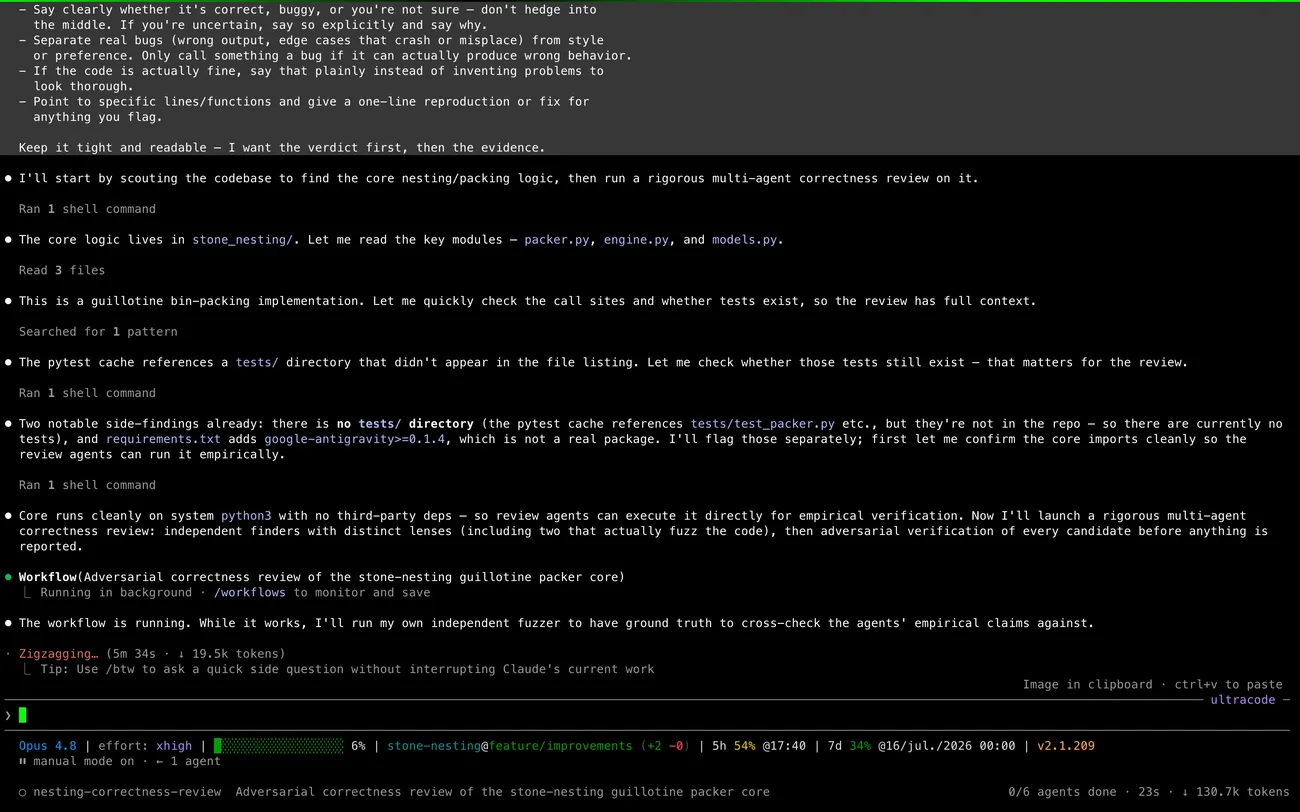
Past max sits ultracode, and it turns the effort setting into orchestration: it runs xhigh and then fans the task out across parallel subagents in one session, Anthropic’s dynamic workflows feature made concrete. We pointed it at a code-correctness review in a real project: it scouted the codebase, flagged on its own that there were no tests and a suspicious dependency, then launched an adversarial multi-agent pass and ran its own fuzzer to cross-check the agents’ claims before reporting anything.
Where Opus 4.8 sits in the Claude lineup
Opus 4.8 is the fast, high-end tier — not the outright top, and not the daily default. That middle position is the whole point of it.
Above it sits Claude Fable 5, which scores higher on the hardest agentic-coding benchmarks. But Fable 5 always reasons before it answers, so it’s slow by design and built for background work you don’t wait on. Anthropic ships its real-time consumer experiences on Opus 4.8 for exactly that reason. Below it, Sonnet 5 is the default on Free and Pro and handles most interactive coding at a fraction of the price.
So the honest framing is: reach for Opus 4.8 when the work is serious enough to need real capability but you’re sitting there waiting for the answer. It’s also the more dependable choice for anything production-critical — Fable 5 was pulled offline for nearly three weeks this year under a US export-control order before access came back on July 1, and a model with that history is one to keep a fallback for. Opus 4.8 has had no such interruption.
Benchmarks: real gains, one real regression
The coding numbers are up meaningfully, and Anthropic reports one honest step backward worth knowing.
On the gains: Opus 4.8 posts 69.2% on SWE-bench Pro (the hard variant, real repositories with no answer leakage), up from 64.3% on 4.7, and 88.6% on the standard SWE-bench Verified. Terminal-Bench 2.1, a test of real command-line work, jumped to 74.6% from 66.1%. The most striking figure is on proof-based math — 96.7% on this year’s USA Mathematical Olympiad, against 69.3% for 4.7, on problems that ran after the training cutoff so there’s no contamination. (All figures are from the Claude Opus 4.8 system card.)
Now the caveat we’d want to know as engineers. Opus 4.8 is slightly weaker against prompt injection than 4.7 — a single attack attempt succeeded about 7% of the time without safeguards, dropping back to roughly 2% once deployed safeguards are on. If you’re building agentic pipelines that touch untrusted input, that’s a real thing to design around, not a footnote. Anthropic also removed some business-focused training that had introduced misaligned behavior in 4.7. That made 4.8 a more honest model and, as a side effect, a worse negotiator on one long-running business simulation. That’s a trade we’ll take, but it’s a trade.
What it costs
Opus 4.8 is $5 per million input tokens and $25 per million output on the API, per Anthropic’s pricing — unchanged from 4.7 and 4.6. That’s half the per-token cost of Fable 5 and five times Haiku 4.5. Output is where the bill lands, since most real workloads generate far more than they read.
Fast mode is priced separately: the same model at up to 2.5x the output speed for a premium, now about three times cheaper than it was on earlier Opus models. One practical note — Opus is the most token-hungry model in the family, and 4.8 defaults to high effort, so it burns tokens faster than people expect. If your task doesn’t need the depth, drop the effort level rather than the model.
Should you use Opus 4.8?
Judged as a working developer’s default, Opus 4.8 is easy to recommend. We run it every day as the model behind Claude Code, and the two things that stand out in real use match the benchmarks: it’s noticeably more willing to say “I’m not sure this is right,” and it narrates and asks more than 4.7 did — helpful on unfamiliar code, occasionally chatty on routine work you’d rather it just finish.
Reach for it when quality is the constraint and you’re waiting on the answer. Drop to Sonnet 5 for the interactive coding that fills most of a day, and move up to Fable 5 only for long, autonomous jobs that run in the background. Learn the effort dial, keep it at high unless the task earns more, and Opus 4.8 earns its place as the model you keep coming back to.
One honest note on where this review stands: the benchmark figures here are Anthropic’s own, verified against its system card. Our hands-on read comes from daily use in Claude Code — including the honesty pass shown above — rather than a formal, scored test bench; a numbers-in, numbers-out A/B across the effort levels is still work we’ll add. Treat the verdict as informed and lived-in, not lab-certified.
See also: Claude models compared: Fable 5 vs Opus vs Sonnet vs Haiku · Claude Fable 5 review · Claude vs Codex · AI tool reviews
Frequently asked questions
Is Claude Opus 4.8 worth it?
For serious coding and agentic work you wait on in real time, yes — it's Anthropic's strongest fast model, and the honesty gains make it safer to trust in production. For everyday chat and simple edits it's overqualified and token-hungry; Sonnet 5 is the cheaper default. And if your work is long, autonomous, and can run in the background, Fable 5 is the better tool.
What's different between Opus 4.8 and Opus 4.7?
Three things stand out: better honesty (Anthropic says it's about four times less likely to hide flawed code), a set of effort controls that let you trade quality for speed and cost, and a cheaper fast mode. Coding benchmarks are up across the board. There's one regression worth knowing — prompt injection is slightly easier against 4.8 than 4.7 without safeguards.
Which effort level should I use on Opus 4.8?
Start at high, the default — it's the best balance of quality and token spend for most work. Use xhigh for hard coding and agentic tasks (it's what Claude Code runs by default). Reserve max for problems where correctness matters more than cost, and know that on very long, multi-step tasks max can sometimes do worse than high, not better.
How much does Claude Opus 4.8 cost?
On the API, $5 per million input tokens and $25 per million output, unchanged from Opus 4.7 and 4.6. That's half the price of Fable 5 and five times Haiku 4.5. Fast mode runs the same model at up to 2.5x the output speed for a premium, and Anthropic made that premium cheaper with 4.8.