Last updated on
Claude Fable 5 review: the most capable Claude yet
The short version: Claude Fable 5 is the most capable model Anthropic has shipped to the general public, and unless your work is genuinely hard, you shouldn’t be using it. It’s built for a narrow, demanding job — long, autonomous agentic runs and the kind of reasoning that breaks lesser models — and it’s priced and tuned so heavily for that job that using it as a general assistant is a waste of money and patience.
That’s the whole review in one paragraph. The rest is where that judgment comes from.
What you’re actually paying for
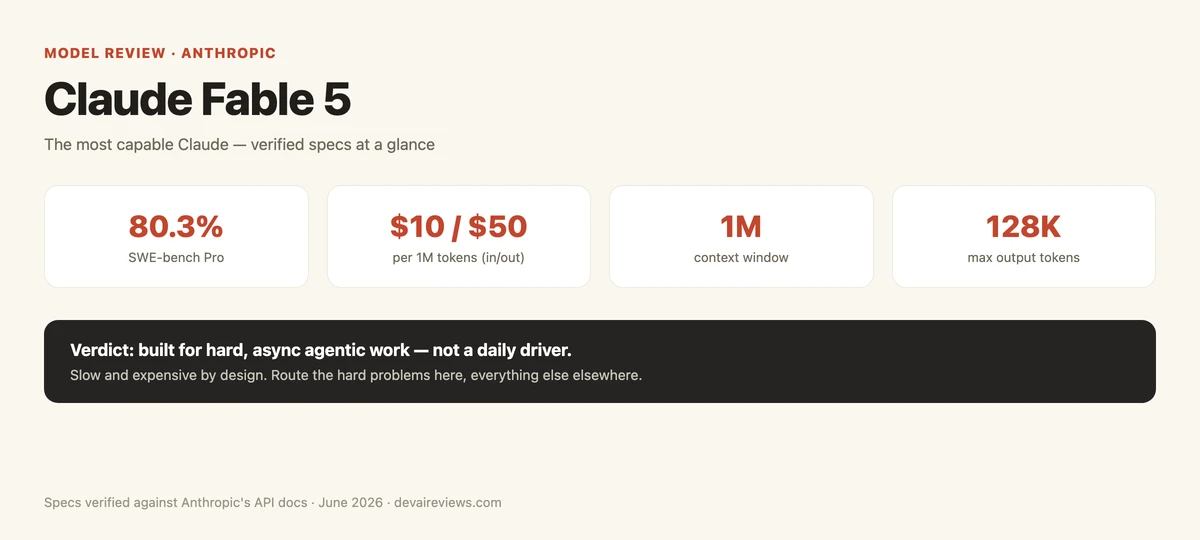
Fable 5 (claude-fable-5) sits at the top of Anthropic’s lineup, above the Opus 4.x models. The headline numbers, from Anthropic’s launch announcement: a 1 million-token context window, up to 128K output tokens per response, and 80.3% on SWE-bench Pro — the highest score of any current model on that benchmark, where the model has to read a real repository, find the bug, and ship a working fix.
The benchmark gap over Opus 4.8 (69.2% on the same test) looks modest until the tasks get harder. The pattern Anthropic describes is consistent: on short tasks, Fable 5 and Opus 4.8 land in similar territory; the gap opens as the task runs longer and the agent has to hold context across many steps without losing the thread. The starkest illustration is FrontierCode, Cognition’s benchmark scored on the hardest 50 of 150 coding tasks: at its highest effort setting, Anthropic puts Fable 5 at 29.3%, against 13.4% for Opus 4.8 and 5.7% for GPT-5.5. The absolute scores are low — these problems are meant to be brutal — but Fable 5 roughly doubles the next-best model on exactly the work that’s supposed to be hardest.
The most concrete claim Anthropic makes is a real-world one: in a 50-million-line Ruby codebase, Fable 5 ran a codebase-wide migration in a day — work the company estimates would have taken a team more than two months by hand. For everyday coding that gap doesn’t matter; for a migration that would take a senior engineer a week, or debugging that spans a whole repository, it’s the difference between a tool that finishes and one that drifts.
A caveat up front: it had a three-week outage, and it’s worth knowing why
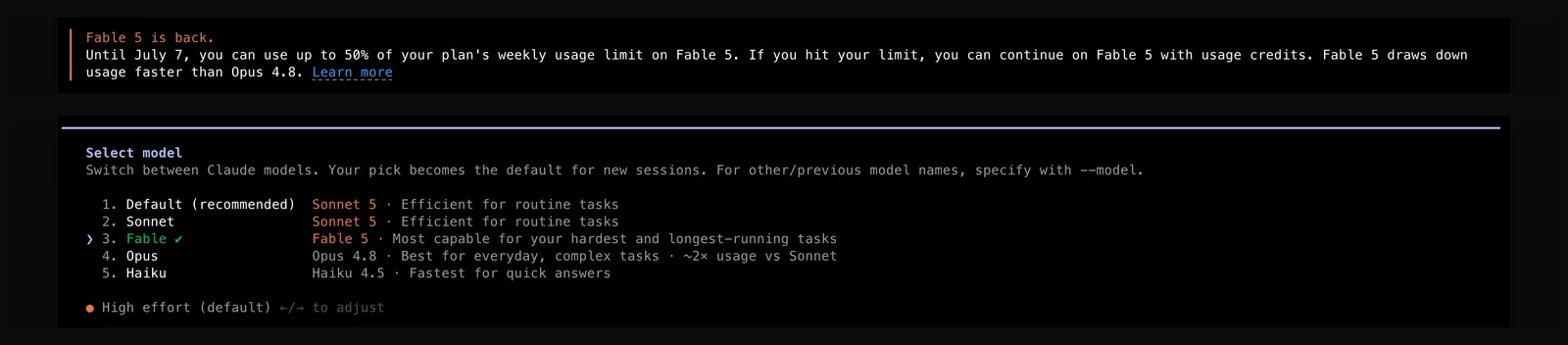
Before anything else, some recent history that’s relevant to trusting this model with real work. Fable 5 wasn’t just hard to get into for a while — it went fully offline. On June 12, 2026, the US government issued an export-control directive after finding what Anthropic calls a “narrow, non-universal jailbreak” tied to cybersecurity tasks (asking the model to read code and identify flaws). Anthropic disabled both Fable 5 and its sibling Mythos 5 for all customers to comply, saying it disagreed with the decision (Anthropic’s statement). Access came back on July 1, 2026, and through July 7 Fable 5 usage counts toward up to 50% of a plan’s weekly limit before switching to usage credits.
That history shapes how to read the rest of this review. Access was only restored a day before this update, so we haven’t yet run our own long-horizon benchmark on Fable 5 — everything below is reasoned from Anthropic’s published specs and the verified pricing and behavior in its API documentation, not from a hands-on test. We’ll add real timings and screenshots from an actual run soon. Treat the verdict as informed analysis, not a hands-on trial — and if you’re planning production work around Fable 5, build in a fallback path given it’s already had one multi-week outage this year.
Before you write that fallback yourself, know which failure you’re handling. A regulatory pull is the rare case; the one you’ll actually hit is a 529 overloaded_error, which means Anthropic’s shared capacity is saturated rather than anything being wrong with your request — a different thing from a 429, and something the official SDKs already retry for you.
The catch: it’s slow, and that’s deliberate
This is the part a spec sheet won’t tell you. Fable 5 is slow. A coding task that Opus 4.8 finishes in 3 to 15 seconds can take Fable 5 a minute or more, and a multi-step agentic run with tool use can run for tens of minutes to several hours.
That’s not a defect. It’s the design. Fable 5 always reasons before it answers — adaptive thinking is on by default and can’t be turned off — and on hard work it thinks a lot. The intended pattern is “hand it a complete task and come back to a result,” not “ask it a question and wait.” If you wire it into an interactive chat loop where a human is staring at a spinner, you’ve picked the wrong model. Anthropic builds the consumer-facing fast experiences on Opus 4.8 for exactly this reason.
So before you adopt it, the real question isn’t “is it good enough.” It’s “is my workload asynchronous.” If the answer is no, stop here and use Sonnet 5 or Opus 4.8.
What it costs
On the API, Fable 5 runs $10 per million input tokens and $50 per million output, per Anthropic’s pricing. Opus 4.8 is $5/$25 for the same — so Fable 5 is double the price per token, and ten times the output price of Haiku 4.5.
Output is where the bill lands, because most real workloads generate far more than they consume. Generating 100K output tokens on Fable 5 costs $5; the same on Haiku is $0.50. For a one-off hard problem, the price is irrelevant. For a pipeline running thousands of requests a day, it’s the whole architecture conversation — which is why the right pattern is almost never “run everything on Fable 5” but “route the genuinely hard steps to Fable 5 and everything else to something cheaper.”
The quirks you’ll hit on day one
A flagship model with a narrow purpose comes with sharp edges. These are the ones worth knowing before you commit, and they’re the kind of thing that turns a smooth integration into a frustrating afternoon.
Thinking is always on, and you can’t see the raw reasoning. There’s no “disabled” mode — sending one returns an error. You can ask for a readable summary of the reasoning, but the raw chain of thought is never returned. If your app surfaces model reasoning to users, plan for summaries, not transcripts.
No assistant prefill. If you’ve been steering output format by pre-filling the assistant’s turn, that pattern returns an error here. Use structured outputs or a system prompt instead.
30-day data retention is mandatory. Fable 5 is not available to organizations running zero data retention. If your compliance posture requires ZDR, every request returns an error regardless of how clean the payload is — so this is a hard gate, not a tuning problem. Check it before you build.
Refusals are your job to handle. Anthropic runs safety classifiers on incoming requests, focused on research biology and most cybersecurity content. When one fires, the API returns a refusal instead of an answer — and it occasionally fires on legitimate adjacent work, like security tooling or life-sciences tasks. In Anthropic’s consumer apps, a refused request quietly falls back to Opus 4.8. On the API, that fallback is opt-in: you add a server-side fallbacks parameter, or a refusal just fails the call. If you’re building on Fable 5, wire that in from the start rather than discovering it in production.
None of these are dealbreakers, but they reward reading the docs before writing the integration.
Who should use it
Reach for Fable 5 when the work is actually hard and runs in the background:
- Large code migrations and framework moves
- Deep debugging that spans a whole repository
- Long agentic runs where an agent works on its own across many steps
- Tasks that need the full 128K output in one response
- Parallel sub-agent workflows that have to stay coordinated over a long run
Skip it for everyday coding, chat, summaries, or anything a human waits on in real time. Sonnet 5 handles the interactive coding that fills most of a developer’s day at a fraction of the cost, and Opus 4.8 covers the serious work that doesn’t quite need the flagship. Spending Fable 5 money on those is the most common mistake we’d expect people to make with it.
The verdict
Judged against what it’s for, Fable 5 is the strongest tool in its class — the highest agentic-coding scores available, built to run a hard task to completion without losing the plot. Judged as a general-purpose model, it’s slow, expensive, and overqualified, and it’ll frustrate anyone who reaches for it by default.
So the rating depends entirely on the question. “Is this the best model for long, autonomous, genuinely hard engineering work?” Yes, clearly. “Should it be your daily driver?” No, and Anthropic doesn’t pretend otherwise — it ships the fast experiences on Opus 4.8 for a reason. Buy Fable 5 for the problems that justify it, route everything else elsewhere, and it earns its price. Use it for everything and you’ll wonder why your bill is enormous and your editor feels sluggish.
One honest caveat, repeated because it matters: we haven’t yet been able to put Fable 5 through our own long-horizon benchmark — access to the model only came back on July 1, following the multi-week suspension covered above. The judgment here is reasoned from Anthropic’s published specs and its verified API behavior and pricing, not from a test we ran. We’ll add real timings, a refusal rate on legitimate work, and screenshots of an actual run soon.
This piece is the verdict — whether Fable 5 is worth its price and who should pay it. If what you need instead is the reference material (the full spec sheet, the API parameters, the refusal behavior, and how it stacks against Opus 4.8 and Sonnet 5), that’s in what Claude Fable 5 is and how to use it.
See also: AI tool reviews · Best AI models for developers in 2026 · Best LLM for code generation in 2026 · The complete guide to AI coding assistants
Frequently asked questions
Is Claude Fable 5 worth it?
Only if your work is genuinely hard and runs asynchronously — large migrations, deep repository-wide debugging, long autonomous agent runs. For those, it's the strongest tool in its class. As an everyday assistant it's slow, expensive, and overqualified; Sonnet 5 or Opus 4.8 are the better default for interactive coding.
How much does Claude Fable 5 cost?
On the API, $10 per million input tokens and $50 per million output. That's double Opus 4.8 ($5/$25) and ten times the output price of Haiku 4.5. Since most workloads generate far more than they consume, the output price is what drives the bill.
Why is Claude Fable 5 so slow?
By design. Fable 5 always reasons before it answers — adaptive thinking is on by default and can't be turned off — so a task Opus 4.8 finishes in seconds can take it a minute or more, and a multi-step agent run can take much longer. It's built for 'hand it a task and come back to a result,' not interactive chat.
Can I use Claude Fable 5 right now?
Yes, as of July 1, 2026. A June 12 US export-control directive tied to a jailbreak finding forced Anthropic to pull Fable 5 and Mythos 5 for every customer; access was restored on July 1, with Fable 5 usage counting toward up to 50% of a plan's weekly limit through July 7 before switching to usage credits. Worth knowing that it had a multi-week outage once already this year.