Last updated on
What is Claude Fable 5? Features, pricing, and how to use it
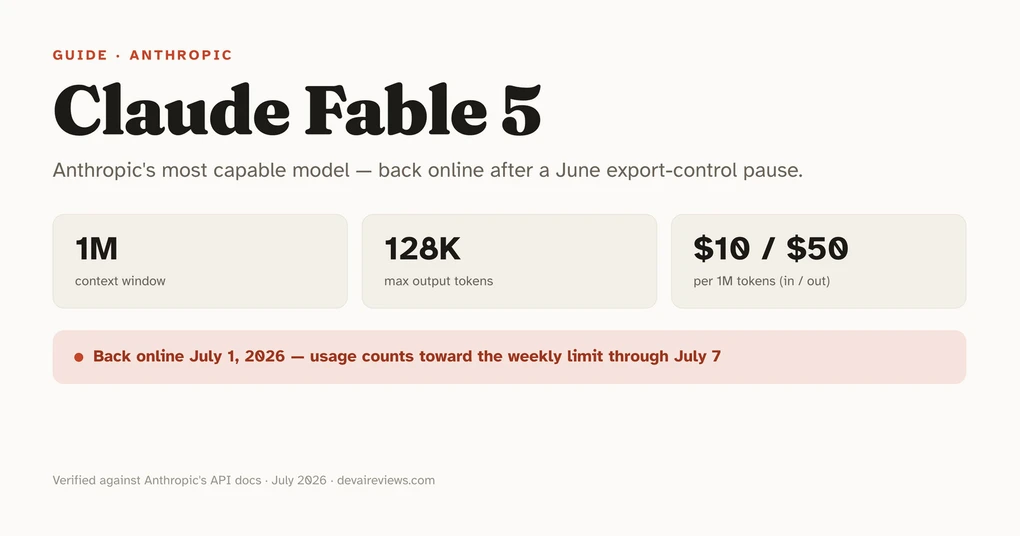
Claude Fable 5 is the most capable model Anthropic has released to the general public (Anthropic’s launch announcement). It’s aimed at hard reasoning and long-horizon agentic work, meaning tasks where an AI agent runs on its own across many steps — exactly where earlier models tended to lose track of what they were doing. One thing worth knowing up front: Fable 5 spent nearly three weeks completely offline this year while Anthropic complied with a US export-control directive — it’s back now, but the outage is relevant context if you’re planning to depend on it (more below).
What is Claude Fable 5?
Claude Fable 5 sits at the top of Anthropic’s current lineup, above the Claude Opus 4.x models. It comes with a 1 million–token context window, which is also the default, so there’s nothing to switch on. And it can return up to 128K output tokens in a single response.
The real story isn’t size, though. It’s autonomy. Fable 5 is built to work through complex, multi-step problems without dropping the context it picked up along the way, and that’s usually the point where long agentic runs fall apart.
What Claude Fable 5 is good at
For developers, the strengths land on real engineering work:
- Code migrations and debugging — moving a codebase from one framework to another, and catching real bugs instead of surface-level nits.
- Searching repository history — reasoning over a project’s past commits and changes, not just the code as it stands today.
- High-resolution vision — reading dense or low-quality images: charts, technical docs, screenshots. When one is flipped, blurry, or noisy, it knows to reach for tools like cropping or shell commands.
- Parallel sub-agents — handing independent subtasks to other agents and keeping them coordinated while they run.
Put plainly, this is the work you’d give a senior engineer, not something you’d expect from quick autocomplete.
Pricing
All that capability isn’t cheap. On the Claude API pricing, Fable 5 costs:
- $10 per million input tokens
- $50 per million output tokens
Claude Opus 4.8, by comparison, runs $5 / $25 for the same amounts, so Fable 5 is roughly double the price per token. Treat it as the model you reach for when a task actually calls for it, not your default for everything.
How to use Claude Fable 5
On the Claude API, you call it with the model string claude-fable-5, using the same Messages API and tool-use patterns as the rest of the Claude 4.x family.
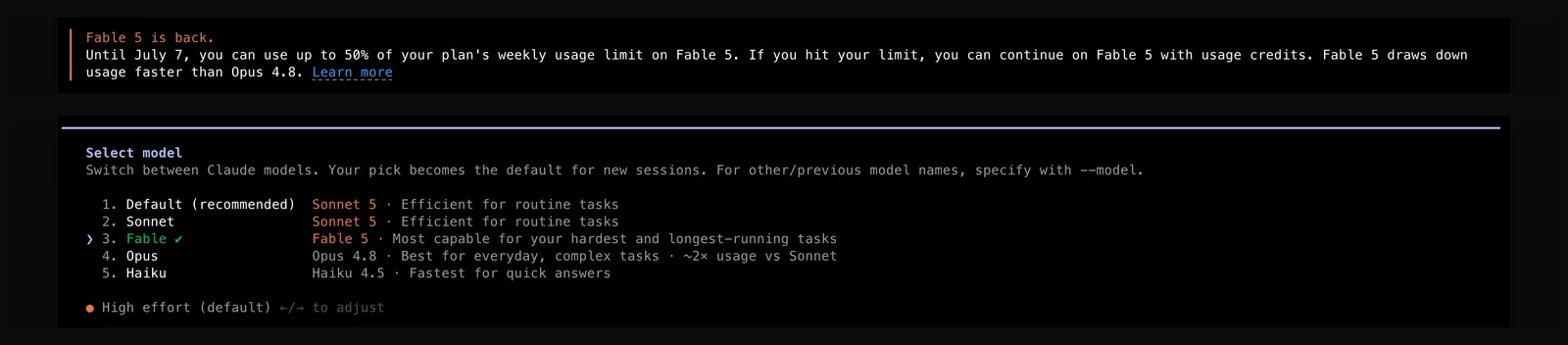
A heads-up on availability first, since it’s recent enough to matter. On June 12, 2026, the US government issued an export-control directive over a narrow jailbreak finding tied to cybersecurity work, and Anthropic disabled both Fable 5 and its sibling Mythos 5 for all users to comply — it said it disagreed with the call. Access was restored on July 1, 2026, and through July 7 Fable 5 usage counts toward up to 50% of a plan’s weekly limit before switching to usage credits. The code below is live and usable today, but it’s worth building in a fallback path (see the Safety and refusals section below) given the model has already had one multi-week outage this year.
A minimal call from a TypeScript project looks like this:
import Anthropic from "@anthropic-ai/sdk";

const client = new Anthropic(); // reads ANTHROPIC_API_KEY from the environment

const response = await client.messages.create({
  model: "claude-fable-5",
  max_tokens: 16000,
  // No `thinking` config here: Fable 5 reasons by default, and passing an
  // explicit thinking mode (enabled/disabled) returns a 400. Control depth
  // with `output_config.effort` instead.
  messages: [
    { role: "user", content: "Refactor this module and explain the trade-offs." },
  ],
});

// `content` is a list of typed blocks — narrow by type before reading text.
for (const block of response.content) {
  if (block.type === "text") console.log(block.text);
}
A few behaviors are worth knowing before you wire it in:
- Thinking is always on. Fable 5 reasons before it answers, and there’s no way to switch that off. You can ask for a readable summary of that reasoning, but it never hands back the raw chain of thought.
- No assistant prefill. To control the output format, use structured outputs or a system prompt instead of pre-filling the assistant’s turn.
- 30-day data retention is required. If your organization runs on zero data retention, you can’t use Fable 5.
Safety and refusals
Anthropic runs safety classifiers on every incoming request, mainly around research biology and most cybersecurity content, which aren’t what Fable 5 is for. When a classifier turns a request down, the API returns a “refusal” instead of an answer.
In Anthropic’s consumer apps, a turned-down request quietly falls back to Claude Opus 4.8. On the API, that fallback is opt-in, so you have to add it yourself or the refusal just fails the call. If you’re building on Fable 5, set it up from day one, because legitimate work near those topics can occasionally trip a classifier.
const response = await client.beta.messages.create({
  model: "claude-fable-5",
  max_tokens: 16000,
  // Opt into the server-side fallback: a declined request is re-served by
  // Opus 4.8 inside the same call, so one classifier hit doesn't fail the run.
  betas: ["server-side-fallback-2026-06-01"],
  fallbacks: [{ model: "claude-opus-4-8" }],
  messages: [{ role: "user", content: userInput }],
});

// Always check `stop_reason` before reading `content`.
if (response.stop_reason === "refusal") {
  // Even the fallback declined. `stop_details` carries the policy category.
  console.warn("Declined:", response.stop_details?.category);
} else {
  const text = response.content.find((b) => b.type === "text");
  console.log(text?.text);
}
Without the fallbacks block, a refused request comes back with stop_reason: "refusal" and an empty content array — and the call simply stops. Code that reads response.content[0] without checking stop_reason first will break on the first declined request.
Claude Fable 5 vs Opus 4.8 vs Sonnet 5
Here’s how the three sit next to each other on the specs and the API price, per million tokens:
| Model | Context window | Max output | Input / 1M | Output / 1M |
|---|---|---|---|---|
| Claude Fable 5 | 1M | 128K | $10 | $50 |
| Claude Opus 4.8 | 1M | 128K | $5 | $25 |
| Claude Sonnet 5 | 1M | 128K | $3 | $15* |
*Sonnet 5 launched with introductory pricing of $2/$10 through August 31, 2026.
The context window and output ceiling are now the same across all three. The gap that’s left is price: Fable 5 costs double Opus 4.8 per token, and you pay it for the hardest reasoning and the longest agentic runs. Opus 4.8 is the sensible default for most serious work, and Sonnet 5 is the fast, cheaper option when the task isn’t that demanding — Anthropic’s biggest gains in its latest update actually landed on Sonnet, not the flagships.
One more name you might run into: Claude Mythos 5. It’s the same capabilities, pricing, and API behavior as Fable 5 — the only difference is access, through Anthropic’s invite-only Project Glasswing program. For everyone else, Fable 5 is the one to use.
Should you use it?
If your work is genuinely hard — large migrations, deep debugging, or agents that run for many steps on their own — Fable 5 is the most capable thing Anthropic offers, and the price says as much. For everyday coding help, summaries, or chat, a cheaper model like Claude Opus 4.8 or Sonnet 5 will handle it fine for a fraction of the cost.
One thing to factor into that decision: access to Fable 5 only came back on July 1 after a nearly three-week export-control suspension, so we haven’t yet been able to put it through our own long-horizon benchmark — the summary here is based on Anthropic’s published specs and verified API behavior, not a hands-on test. For the deeper look at the benchmarks and the shutdown, see our Claude Fable 5 review; we’ll follow up soon with hands-on results and how it compares to the tools we already cover.
See also: Best AI models for developers in 2026 · Best LLM for code generation · More developer guides
Frequently asked questions
What is Claude Fable 5?
Claude Fable 5 is Anthropic's most capable widely released model, aimed at hard reasoning and long-horizon agentic work — tasks where an agent runs on its own across many steps without losing track. It sits above the Opus 4.x models in Anthropic's lineup, with a 1 million-token context window and up to 128K output tokens per response.
How much does Claude Fable 5 cost?
On the Claude API, $10 per million input tokens and $50 per million output. That's roughly double Claude Opus 4.8 ($5/$25 for the same), so it's the model you reach for when a task genuinely calls for it — not your default for everything.
How do I use Claude Fable 5?
On the Claude API you call it with the model string claude-fable-5, using the same Messages API and tool-use patterns as the rest of the Claude 4.x family. Note two things: thinking is always on (passing an explicit enabled or disabled thinking mode returns an error — control depth with output_config.effort), and access was briefly suspended — Anthropic disabled Fable 5 for all customers from June 12 to July 1, 2026 to comply with a US export-control directive. It's back online now, with usage counting toward up to 50% of a plan's weekly limit through July 7.
Should I use Claude Fable 5 or a cheaper Claude model?
Use Fable 5 only when the work is genuinely hard — large migrations, deep debugging, or agents that run many steps on their own. For everyday coding help, summaries, or chat, Claude Opus 4.8 or Sonnet 5 handle it fine at a fraction of the cost.