Last updated on
Why companies are suddenly capping AI token spend
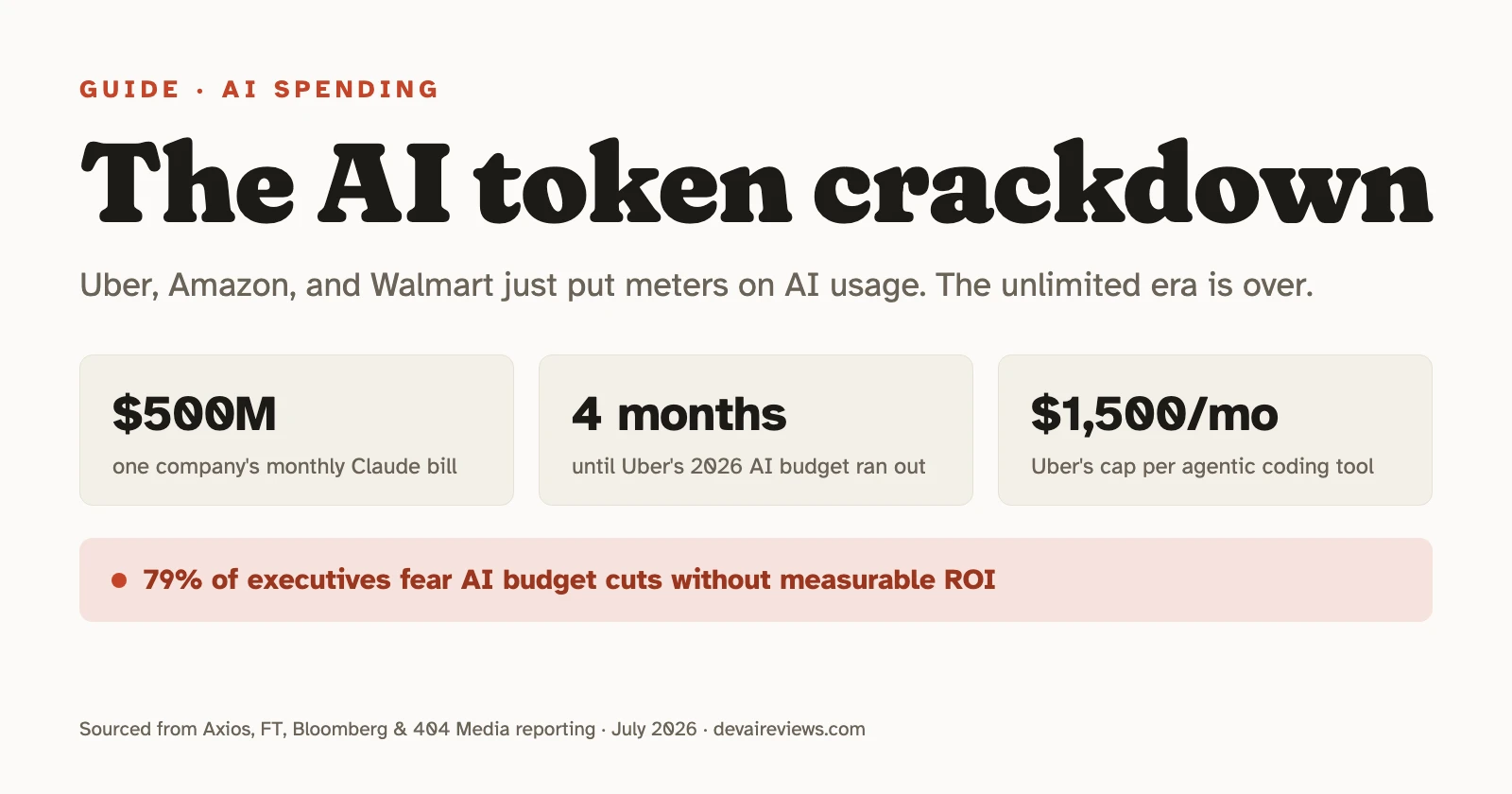
TL;DR: The era of “use as much AI as you want” is over. Uber blew through its entire 2026 AI budget in four months and now caps engineers at $1,500 a month per coding tool. One company reportedly spent $500 million on Claude in a single month because nobody set usage limits. Amazon killed an internal leaderboard that rewarded AI usage after employees gamed it. If you write code for a living, a token budget is probably coming to your team — and the engineers who can do more with fewer tokens are about to look very good.
The $500 million month that changed the conversation
The story that crystallized all of this: an AI consultant told Axios in May that one of their enterprise clients spent half a billion dollars on Anthropic’s Claude in a single month. Not on a breakthrough project. The company simply never configured usage limits, and employees were free to consume as much as they wanted.
To be precise: this is a secondhand account of an unnamed company, not an audited bill. But nobody in the industry treated it as implausible, and that’s the tell. Agentic tools that run multi-step tasks autonomously can consume orders of magnitude more tokens than a single chat query, because every step of the loop — plan, act, read the result, plan again — bills its own context.
That’s the mechanism behind “tokenomics,” the word the industry has landed on for per-token cost management. Flat-fee unlimited plans made AI spend predictable. Metered agentic usage does not, and the first year of real agentic adoption is producing the first wave of shocking invoices.
Tokenmaxxing: what happens when you reward usage
Before the caps came the leaderboards. Amazon had an internal ranking called Kirorank that scored employees by how often they used AI in their day-to-day work. The incentive worked exactly as designed, which was the problem: employees started assigning AI agents pointless tasks to climb the rankings, and every one of those tasks burned compute Amazon paid for. The Financial Times, which broke the story, reports Meta employees gamed similar internal tables the same way.
The practice got a name: tokenmaxxing, inflating token consumption to look productive. Amazon senior VP Dave Treadwell told staff the leaderboard was built with “good intentions” but encouraged exactly that behavior, and shut it down: “Please do not use AI just for the sake of using AI.” (Amazon later distanced itself further, calling it an employee-created beta dashboard that “was not a formal or approved tool.”)
The replacement metric is the interesting part. Per the FT, Amazon now tracks “normalised deployments” — evidence that engineers use AI to ship working code — instead of raw token consumption. Cognizant CEO Ravi Kumar S put the same idea more bluntly, calling token consumption a “vanity metric.” Measure usage and you get usage. Shipped code is harder to fake.
Why did Uber cap Claude Code spending?
Uber is the cleanest case study because the numbers are public. The company exhausted its entire 2026 AI budget by April, roughly four months into the year, after Claude Code spread across its ~5,000-engineer org faster than finance had modeled. Per-engineer spend was running $500 to $2,000 a month.
The response: Uber now caps employees at $1,500 per month per agentic coding tool, such as Claude Code or Cursor. The awkward part is that this came after Uber had told employees to use AI as much as possible. First the mandate, then the bill, then the cap. Expect that sequence to repeat at a lot of companies.
It’s not just engineers burning the budget
The assumption was that coders would drive the cost. Leaked audio from an Accenture internal meeting, obtained by 404 Media, says otherwise. “It’s actually not our engineers that are driving the token consumption,” Accenture’s agentic AI strategy lead Justice Kwak said in the recording. “It’s a lot of the non-engineers that are doing some of those behaviors” — things like feeding large PDFs to frontier models to turn them into presentation slides.
There’s an irony here: Accenture had reportedly made AI usage a factor in senior-staff promotions, per TechCrunch, a policy that fuels exactly the low-value usage it’s now trying to curb. Walmart, meanwhile, put per-employee token allotments on Code Puppy, its in-house AI agent, after demand took off.
The industry response: standards, surveys, and caveman-speak
Four things are happening at once.
Standardization. The Linux Foundation announced the Tokenomics Foundation, an effort to build open standards and benchmarks for AI cost management, working alongside the FinOps Foundation. Provisional backers include Accenture, Google Cloud, IBM, JPMorgan Chase, Microsoft, Oracle, Salesforce, and SAP. When that roster agrees AI billing needs a standards body, the cost problem is officially structural.
Executive anxiety. A Wakefield Research survey for Lanai found 79% of executives are concerned their AI budgets could be cut if spending isn’t tied to measurable business results. The blank-check phase is over; the show-me-the-ROI phase has started.
Token frugality as a practice. The viral example is caveman, an open-source agent skill (404 Media notes a senior OpenAI employee has contributed code to it) that makes models answer in terse caveman-speak — “why use many token when few token do trick” — while keeping code and commands byte-for-byte exact. It’s a gimmick with a real point: most agent output is prose you’ll never read, and you’re paying output-token rates for it. Independent benchmarks found a plain “be concise” instruction captures most of the savings, but the fact that engineers are benchmarking politeness overhead at all tells you where the culture is going.
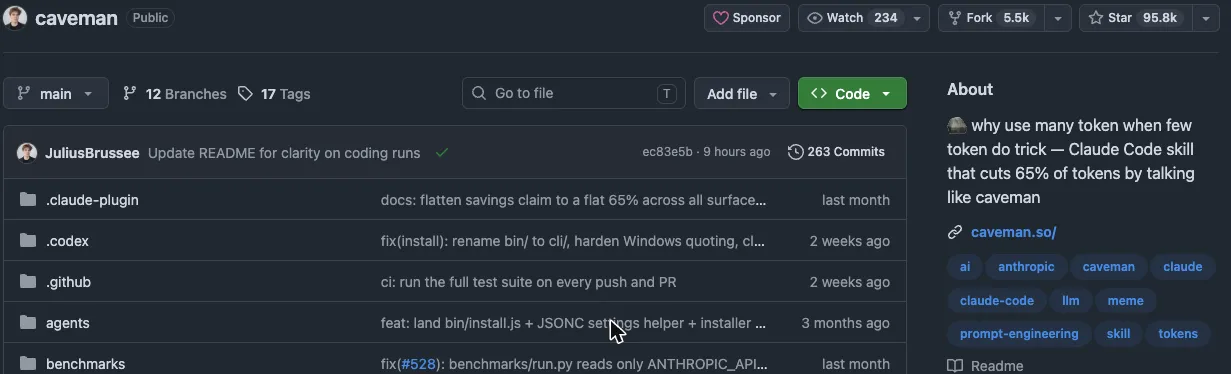
The star count is the part worth reading as a signal. A joke skill does not collect 95,800 stars unless a lot of engineers recognize the underlying bill.
The vendors are building the cap in. This is the newest of the four and the one that changes the most. On August 7, 2026 Anthropic shipped session budgets for Managed Agents: a hard ceiling on what a single agent session can spend, priced at public list rates. Hit it and the session doesn’t degrade or warn — it stops, with a budget_reached stop reason, and resumes only when someone raises or removes the budget. Deployments pass the same budget down to every session they start.
That matters more than a finance dashboard does. Every cap described above is enforced after the fact, by a human reading a bill; this one is enforced by the API, before the tokens are spent. If you run agents unattended, it’s the difference between finding out on the invoice and finding out in a stop reason. Expect the rest of the field to ship the same control, because the runaway-agent bill is the specific fear that makes procurement slow.
The more interesting model is Coinbase, which cut its AI spend nearly in half without capping engineers: cheaper open-weight models as the default through an internal LLM gateway, automated routing to bigger models only when needed, and aggressive caching. Notably, Coinbase found 91% of employees never hit usage caps anyway. The waste wasn’t people using AI too much — it was every request defaulting to the most expensive model.
What this era shift looks like
| Subsidized era (2023–2025) | Token era (2026–) | |
|---|---|---|
| Billing | Flat fee, "unlimited" | Metered, per token |
| Adoption push | Mandates and leaderboards | ROI scrutiny and spending caps |
| Default model | The flagship, always | Cheapest model that does the job, routed up when needed |
| Who's accountable | Nobody (it's in the innovation budget) | Whoever's cost center the tokens land in |
What this means if you write code for a living
Two practical takeaways.
First, assume a token budget is coming to your team if it hasn’t already, and that agentic coding tools will be the first thing capped — they’re the biggest line item and the easiest to meter. Uber’s $1,500/month figure is a useful reference point for what “generous but capped” looks like for a working engineer; for scale, the flat subscriptions these tools sell run from $10 to $200 a month per seat in our verified pricing tracker, so a $1,500 cap is really about API and usage-based overages, not the base plans.
Second, token efficiency is quietly becoming an engineering skill. The teams that survive budget scrutiny won’t be the ones that use AI least; they’ll be the ones that can show what a token buys. On the API side, the mechanics are well understood. We walked through them in 8 engineering levers to cut LLM API costs, the practical companion to this piece in our developer guides: prompt caching, model routing, context trimming, output caps. Coinbase’s playbook is essentially those levers applied at company scale, and it beat blunt caps on both cost and developer happiness. If you’re picking which models to route to, our rundown of the best AI models for developers in 2026 covers the price-per-capability spread.
The companies clamping down aren’t concluding that AI doesn’t work. Uber capped Claude Code because 5,000 engineers adopted it in months — the tool won so hard it broke the budget. The correction is about who pays attention to the meter. For the next few years, that’s going to be you.
Frequently asked questions
What is tokenmaxxing?
Tokenmaxxing is inflating AI token consumption to look productive — running unnecessary AI calls because usage itself is being measured or rewarded. The term spread after Amazon shut down Kirorank, an internal leaderboard that ranked employees by AI usage, once staff started assigning agents pointless tasks to climb the rankings. Amazon now tracks whether AI helps ship working code instead.
Why did Uber cap AI spending?
Uber exhausted its entire 2026 AI budget by April, about four months in, after Claude Code adoption spread across roughly 5,000 engineers faster than finance had modeled. Per-engineer spend ran $500 to $2,000 a month. Uber now caps employees at $1,500 per month per agentic coding tool, such as Claude Code or Cursor.
What is the Tokenomics Foundation?
It's a Linux Foundation initiative announced in 2026 to set open standards, benchmarks, and best practices for AI cost management — think FinOps, but for tokens. Provisional supporters include Accenture, Google Cloud, IBM, JPMorgan Chase, Microsoft, Oracle, Salesforce, and SAP.
Do spending caps actually reduce AI costs?
They stop the bleeding, but they're a blunt tool. Coinbase found 91% of its employees never hit usage caps anyway, and cut its AI spend nearly in half through engineering instead: cheaper default models via an internal gateway, automated routing, and aggressive caching — while token usage kept growing.