Last updated on
Kimi K3: what the 2.8T open-weight model means for devs
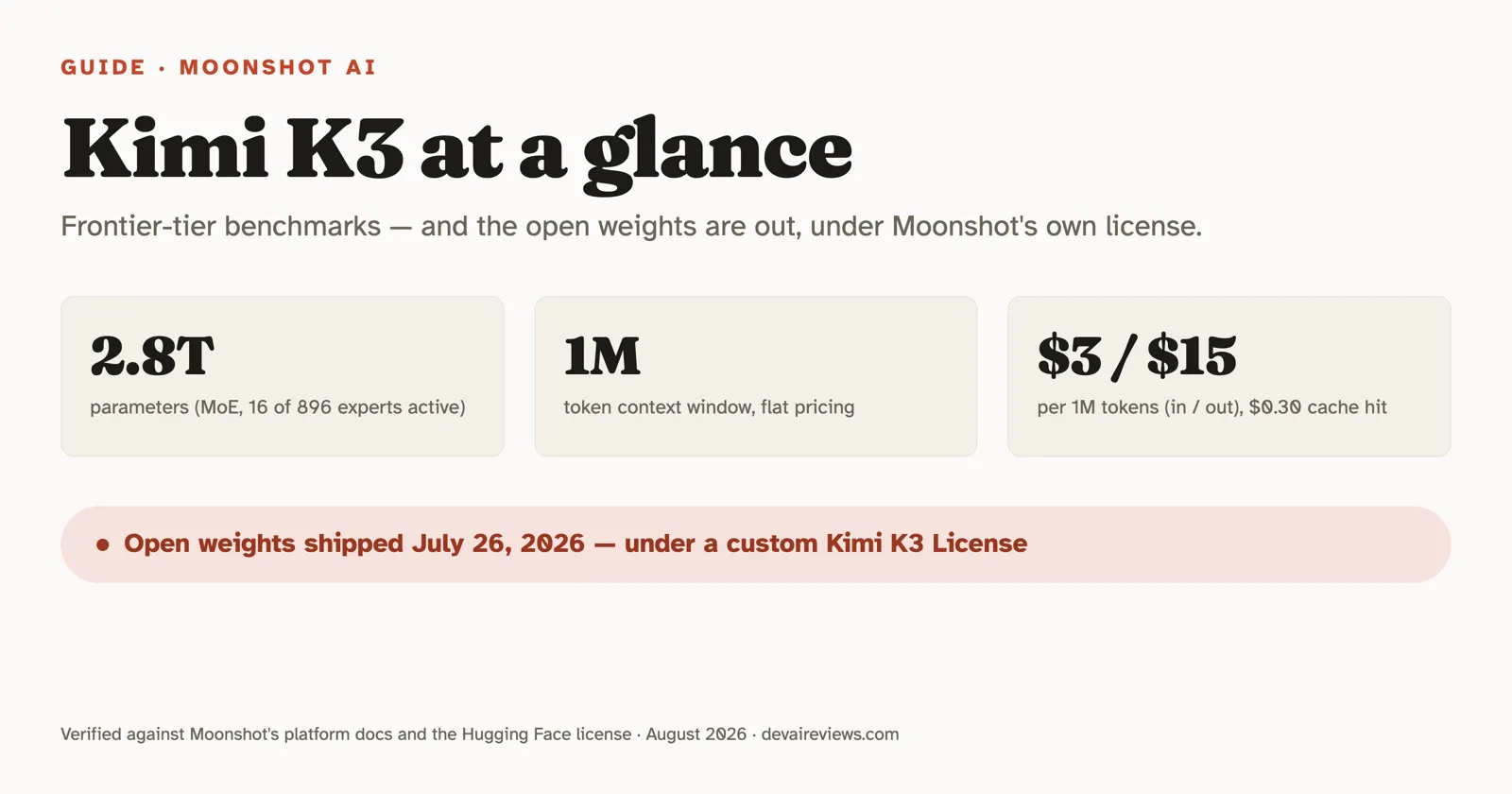
Moonshot AI released Kimi K3 on July 16, 2026: a 2.8 trillion-parameter model that benchmarks in frontier territory and costs $3 per million input tokens and $15 per million output on the official API (Moonshot’s announcement). The headline claim: when the weights ship (promised by July 27), it will be the largest open-weight model ever released. We haven’t run our own hands-on test yet — this is what the specs, the pricing page, and the early independent data actually say, and where we’d be careful before wiring it into a workflow.
TL;DR
- 2.8T-parameter Mixture-of-Experts (16 of 896 experts active), native vision, 1M-token context.
- Frontier-tier benchmarks: top-5 on Artificial Analysis, #1 on Arena’s WebDev coding leaderboard at launch.
- API is $3/$15 per million tokens, flat at any context length; cache-hit input is $0.30.
- The weights shipped on July 26 — but under a custom license with revenue-triggered conditions, not the Modified MIT that K2 used.
- The trap for developers: K3 burns 2–3× more tokens per task than comparable models, so real cost per task is much closer to premium models than the rate card implies.
What is Kimi K3?
Kimi K3 is the third-generation flagship from Moonshot AI, the Beijing startup behind the Kimi chatbot and the K2 open-weight family. It’s a Mixture-of-Experts model (an architecture where only a fraction of the network runs per token) with 2.8 trillion total parameters, of which 16 of 896 experts activate at a time (technical blog). It reads images natively and takes up to 1 million tokens of context.
The architecture is genuinely new rather than a scaled-up K2: Moonshot built it on Kimi Delta Attention (a hybrid linear attention mechanism) plus Attention Residuals, and trained it quantization-aware from the SFT stage using MXFP4 weights, a deliberate move to make the eventual open weights runnable on more hardware (Kimi platform docs).
For scale: K2 and its successors (K2.5 through K2.7 Code) were 1T-parameter models with 256K context. K3 nearly triples the parameter count and quadruples the context window in one jump.
How good is it at coding?
Early numbers put K3 in the frontier tier. That’s exactly why it made mainstream news (Reuters). On Artificial Analysis, it lands just behind Claude Fable 5 and GPT-5.6’s top reasoning settings, and ahead of Claude Opus 4.8 and Sonnet 5. On Arena’s leaderboard it took the #1 spot for WebDev coding at launch. On DeepSWE it scores 67.5 with Moonshot’s own KimiCode harness, and 67.3 on the official leaderboard’s standard mini-SWE-agent harness — close enough that the in-house number holds up.
Two caveats before you extrapolate from leaderboards. First, all of this runs on Moonshot’s hosted infrastructure right now — nobody outside the company has inspected the model itself. Second, launch-week benchmark placements move; Arena rankings in particular churn as votes accumulate. If K3 still holds a top coding slot in mid-August, that will mean more than the launch snapshot does.
If you’re weighing K3 against the models we have tested hands-on, our Claude Fable 5 review and our comparison of Grok, Gemini, and DeepSeek for developers are the reference points.
What does Kimi K3 cost — really?
The rate card is aggressive: as of July 20, 2026, $3 per million input tokens, $15 per million output, $0.30 for cache-hit input, flat at any context length (platform docs). That’s well under frontier US pricing — Claude Fable 5, the model K3 is most often compared to, runs $10/$50 (see our Fable 5 guide).
If you’d rather subscribe than meter tokens, Kimi Code comes bundled into Kimi’s membership tiers — we track them, with limits and price history, in our pricing tracker:
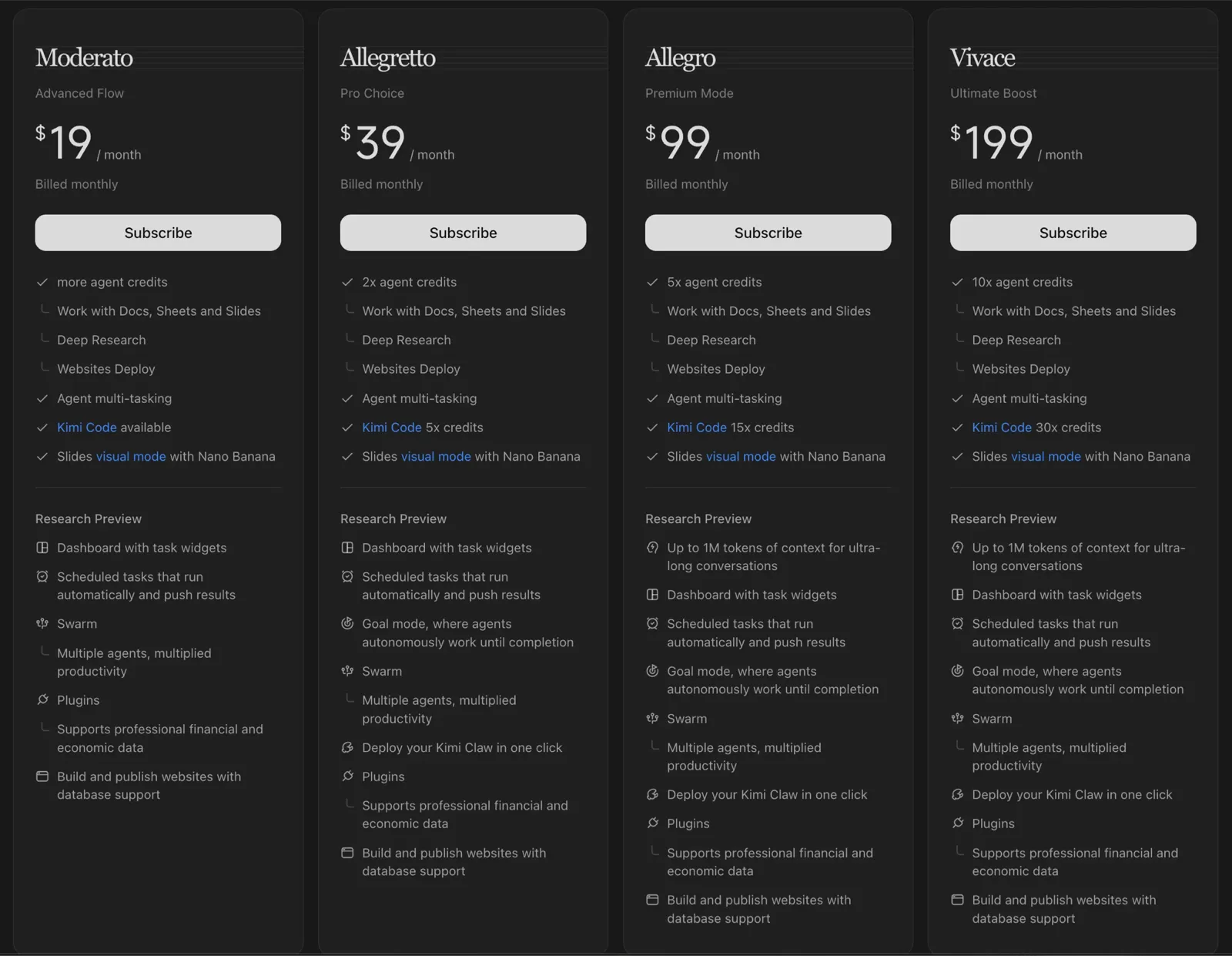
But per-token price isn’t per-task price. Artificial Analysis’s early data shows K3 consuming roughly 2–3× more tokens per task than a thrifty peer like Grok 4.5. It reasons long and verbosely. Early Hacker News reports echo this: one developer found a single task nearly exhausted a five-hour usage window on Kimi’s $19 subscription plan, where the same task barely dented a $20 ChatGPT plan. Cheap rates plus heavy token burn is a pattern we’ve written about before — if you’re testing K3 on a metered API, put spending caps in place first and measure cost per completed task, not per million tokens.
Open weights — shipped, and the license is the story
Moonshot shipped the weights on July 26, 2026, a day ahead of its own deadline. They’re on Hugging Face — 2.8T total parameters, 104B activated, the full 1,048,576-token context — and they have been downloaded well over a million times in the first month. So the “largest open-weight model in the world” line is now a fact rather than a promise.
The license is where it gets less generous than the headline suggests. K2 shipped under a Modified MIT license. K3 does not: it ships under a bespoke Kimi K3 License (tagged license:other on Hugging Face) with two thresholds worth reading before you build on it. Offering K3 as a service requires a separate agreement once “aggregate revenue of the Licensee and its affiliates exceeds 20 million US dollars … in total over any consecutive 12 months.” And past “more than 100 million monthly active users, or more than 20 million US dollars … in monthly revenue,” the license states that “‘Kimi K3’ must be prominently displayed on the user interface of such product or service.”
Neither clause touches a team self-hosting K3 for internal engineering work. That’s most of you. Both matter if K3 would sit under something you sell. Call the model open-weight, not open source — the distinction is doing real work here.
Worth being blunt about what open weights would and wouldn’t mean for you. A 2.8T-parameter model, even in MXFP4, is multi-GPU server territory — this is not a “run it on your MacBook” release the way small open models are. The realistic beneficiaries are inference providers (expect cheaper third-party hosting fast), researchers, and teams with data-residency or compliance reasons to self-host. Also remember that a model trained under Chinese regulation carries state-mandated content constraints in the weights themselves — fine for most coding work, but a real consideration if your product touches topics the model was trained to avoid. Our security and privacy guide for AI coding tools covers how we think about where code and prompts travel.
Should you switch to it?
The sensible move is the boring one: run K3 on a real task from your own backlog, track total tokens, and compare cost-per-completed-task against whatever you use now. You no longer have to go through Moonshot to do it. Since August 6, 2026 K3 is available in GitHub Copilot on the Pro, Pro+, Max, Business, and Enterprise plans, billed by usage at Moonshot’s list rates, and GitHub hosts it on Fireworks AI rather than proxying to Moonshot. It’s off by default on Business and Enterprise until an admin enables the policy. If the reason you skipped K3 was that your prompts would land on a Beijing-operated API, that specific objection now has an answer. That’s exactly the kind of thing open weights were supposed to unlock. We’ll do our own hands-on run and report back — until then, our developer guides cover the models and tools we have put through real work.
If you’re weighing K3 specifically against what you’re paying Anthropic today, the head-to-head is a separate piece: Kimi K3 vs Claude works through the effective cost per task rather than the rate card, which is where the 40% headline gap mostly disappears.
Frequently asked questions
What is Kimi K3?
Kimi K3 is Moonshot AI's flagship model, released July 16, 2026. It's a 2.8 trillion-parameter Mixture-of-Experts model with native vision and a 1M-token context window, aimed at long-horizon coding and agentic work. Moonshot published the weights on July 26, 2026, making it the largest open-weight model released so far.
How much does Kimi K3 cost?
On Moonshot's API, $3 per million input tokens and $15 per million output, with cache-hit input at $0.30. Pricing is flat — there's no tiering by context length, even at the full 1M-token window. The catch is token consumption: Artificial Analysis data puts K3's tokens-per-task well above most peers, so per-task cost is higher than the rate card suggests.
Is Kimi K3 actually open source?
The weights are out — Moonshot published them on Hugging Face on July 26, 2026 — but 'open source' overstates it. Where the K2 family used a Modified MIT license, K3 ships under a bespoke Kimi K3 License that requires a separate agreement to offer the model as a service once your aggregate revenue passes $20 million over any 12 months, and requires 'Kimi K3' to be displayed prominently in your product's interface above 100 million monthly active users or $20 million in monthly revenue. Open weights, yes. OSI-style open source, no.
Can I run Kimi K3 locally?
Realistically, no. Even with MXFP4 quantized weights, a 2.8 trillion-parameter model needs multi-GPU server hardware far beyond a workstation. The open weights matter for hosting providers, researchers, and companies with data-residency requirements — not for running it on your own machine.